Saturday, September 5, 2009

#20 BYU Upsets #3 OU


Heisman Trophy winner Sam Bradford stood helplessly on the sideline, wearing a T-shirt, a sling and a towel around his neck.

All he could do was watch as his Oklahoma Sooners lost their chance for a perfect season—and the BYU Cougars launched their bid to become the latest BCS busters from the Mountain West.

Max Hall threw a 7-yard touchdown pass to wide-open McKay Jacobson in the back of the end zone with 3:03 left, giving No. 20 BYU a 14-13 victory over No. 3 Oklahoma on Saturday night.

The Sooners’ last hope to recover ended when Tress Way came up short on a 54-yard field goal with 1:23 left. BYU players exchanged flying chest bumps right away, then celebrated wildly when their upset was complete, a stunning end to the first college football game—and first regular-season game—ever played at the nearly $1.2 billion Cowboys Stadium.

One Saturday into the college football season and already the national title race—and Heisman Trophy race—have been thrown for a loop.

Cougars fans made up only a small portion of the crowd of 75,437, but they all stuck around long after this one. The team stayed on the field so they could all enjoy it together, cheerleaders waving flags and players pointing to friends and family in the crowd. Hall’s uncle, former Cowboys quarterback Danny White, was expected to be among them.

“I don’t know if we can measure it now,” said BYU coach Bronco Mendenhall, who opened his fifth season with his biggest victory and one of the best in program history. “All I can say is I’m very proud of this football team.”

The Cougars won at least 10 games each of the last three years, helping regain some of their national profile, but they’d lost 12 straight to ranked non-conference foes. Their last such win was over No. 1 Miami in 1990.

“This is unbelievable, playing a game like this, having a chance to drive down the field and score,” Hall said.

Hall was 26 of 38 for 329 yards and two touchdowns. The numbers that matter most: a 16-play, 78-yard drive that included converting a fourth-and-4 and throwing the winning touchdown after being shoved back from the 2 on a delay-of-game penalty.

Hall was intercepted twice and sacked four times, but this win could vault him to the fringe of the Heisman talk—especially with Bradford’s status unknown.

Bradford sprained his throwing shoulder when he was tackled to the turf on a hard, clean hit by linebacker Coleby Clawson in the closing seconds of the first half. Oklahoma kicked a field goal on the next play to up 10-7, but backup Landry Jones wasn’t able to stretch it very much.

The best Jones could do was get the Sooners to the 1-yard line midway through the fourth quarter. After he failed to get in on a third-down sneak, coach Bob Stoops opted for another field goal. Hall made that strategy backfire, leaving Oklahoma 0-1 for only the second time in 11 seasons under Stoops.

Full Article

Ken Niumatalolo's Midshipmen Almost Pull the Epic Upset Over No. 6 Ranked Ohio State

All the elements were in place for an epic upset of No. 6 Ohio State by Navy.

“If Ohio State comes in totally focused on us, we had no chance,” Navy coach Ken Niumatalolo said. “We felt like we had them in the perfect storm.”

The Buckeyes weathered that storm with the help of a college football rarity.

Brian Rolle intercepted a potential tying 2-point conversion in the closing minutes and returned it for two points the other way, helping the Buckeyes hold off pesky Navy 31-27 on Saturday.

“It wasn’t a dazzling fourth quarter for us, by any means,” coach Jim Tressel said in the understatement of the day.

A crowd of 105,092—the largest ever to see the Buckeyes open a season— sat in stunned silence after the 21-point underdog Midshipmen scored twice in 4 minutes to cut a 29-14 deficit to two points with 2:23 left.

Navy went for the tie, but Rolle stepped in front of Ricky Dobbs’ pass and rumbled up the sideline to preserve the win in the Midshipmen’s first trip to Ohio Stadium since 1931—and keep the luster on next week’s rematch between the Buckeyes and No. 4 Southern California.

“I remember a lot of bad things from last year, like that long, silent ride home,” linebacker Austin Spitler said of USC’s 35-3 pasting of the Buckeyes. “It’s up to us now. We’ll have our doubters and now we’ll have to go out and prove we’re good.”

For a while, at least, they were against Navy.

Terrelle Pryor was 14 of 21 for 174 yards, and ran for a touchdown and passed for another to help Ohio State build its lead. But then the Minutemen seemed to make every big play.

Dobbs, who completed 9 of 13 passes for 156 yards and two scores, rolled left and hit Marcus Curry on a 16-yard scoring pass with 1:24 left in the third quarter to cut Ohio State’s lead to 20-14.

The Buckeyes countered with two quick scores.

Aaron Pettrey, who kicked three field goals, made a 52-yarder early in the fourth quarter. Two plays later, Navy’s Mario Washington caught a pass that Ohio State safety Kurt Coleman ripped out of his arms with Ross Homan falling on the loose ball. Three plays after that, Dan Herron took an option pitch and bounced in off left tackle on a 6-yard scoring run to put the Buckeyes up 29-14.

It stayed that way when Pettrey’s extra-point try clanged off the upright.

Navy turned the game around with a defensive stand. The Buckeyes passed on the field-goal attempt and went for it on fourth-and-2 at their own 15 with 6:30 left, but linebacker Tyler Simmons surged forward to stop Herron for no gain.

“I certainly should have kicked a field goal on fourth-and-1,” Tressel said. “That was a huge mistake in my mind.”

On the next snap, Dobbs lofted a perfect spiral over the middle to Curry, who had a step on safety Anderson Russell. Curry then outran everybody to the end zone, completing the third-longest pass play in Navy history. The 85-yard score narrowed the lead to 29-21.

“I made the move and had enough gas to get all the way there,” Curry said. “But I was dying at the end.”

Pryor then overthrew a receiver and Navy safety Emmett Merchant intercepted and returned it 28 yards to the Ohio State 33 with just under 4 minutes left.

Dobbs ran for 4 yards, then passed for 5. On third and 1 at the 24, he faked a handoff and sprinted straight up the middle for the touchdown.

The gasp from the partisan crowd was audible.

Navy called timeout to set up for the 2-point try. Dobbs then took the snap and dropped back, passing over the middle. Rolle was the only player close and the junior thundered up the Navy sideline 99 yards.

“I’d seen it on film, but I was surprised he actually threw it,” Rolle said. “I was like, ‘Wow.”’

“The guy came out of nowhere,” Dobbs said. “I don’t know how he broke on it.”

After getting the onside kick, the Buckeyes—finally, gratefully—were able to run out the clock.

“This game shows we’ve got a long way to go,” Spitler said. “The preparation starts tomorrow.”

Full Article

Friday, September 4, 2009

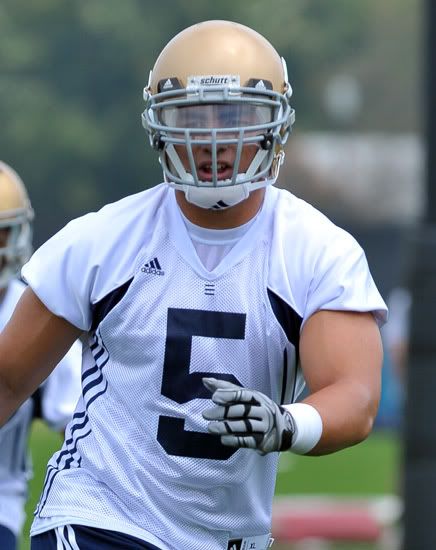
Te'o Hoping to be 'Man of Worth' for Irish


When Manti Te'o arrived at Notre Dame for his official visit last November, he was wearing shorts and a T-shirt.

That was the same weekend Mother Nature dumped almost a foot of snow on South bend, followed by lowly Syracuse dumping the Irish at home and fans throwing snowballs at their own players. No one would have blamed Te'o for dashing through the snow to the airport, catching the first plane back to Hawaii and never stepping foot in Indiana again.

Instead, one of the nation's most coveted recruits embraced the twin challenges of playing so far from home and helping a struggling program get back on its feet. Te'o will make his highly-anticipated college debut on Saturday versus Nevada, and though he won't start, he figures to see a lot of time at weakside linebacker. At 6-foot-2 and 245 pounds, he brings a mix of size and athleticism that the Notre Dame defense has been lacking recently under Charlie Weis.

But Te'o has even larger goals.

"Hopefully I influence a lot of people for good, whether it will be in football or just life in general," he said. "I want to influence people as an example of service to others."

It's easy to see, then, why Te'o chose the Irish, who despite their ups and downs, still hold one the biggest bully pulpits in college football. Speaking publicly for the first time as a collegian at Notre Dame freshman media day last month, Te'o sat at a table surrounded by more than 20 reporters, with eight TV cameras recording his every word.

That's a bit much for any 18-year-old to deal with, and Te'o admits he gets nervous every time he is in front of a camera. But he handled himself like a seasoned vet, which in some ways he is when it comes to heavy attention.

He was, after all, the top high school player in his state, the pride of Hawaii and the target of just about every major college program in the country. He starred at the Punahou School in Honolulu, the alma mater of Barack Obama and the top prep athletic factory in America, according to Sports Illustrated.

"There was never a ride home when I didn't answer the phone for him at least once," says fellow Irish freshman Roby Toma, Teo's best friend since childhood. "He had so much pressure on him. People were always asking him who he was going to sign with. But he always kept a cool head."

On the field, Te'o was a force of nature in high school. In one practice, Toma, a wide receiver, felt the full wrath of his teammate's power. The hit turned Toma's helmet around, leaving him trying to see out his ear hole.

Another time, Toma remembers, Punahou was milking a lead in the state championship game when it gave the ball to occasional fullback Te'o for a dive play on third and long.

"He broke nine tackles," Toma says. "On film, you see me out there blocking, and the play is still going on, but I just turned around and watched. You couldn't help but watch."

Those prodigious skills are why Te'o won the inaugural high school Butkus Award and was rated the No. 2 player in the Class of 2009 by ESPN's Scouts Inc. In an age where defenders are getting smaller and faster to go against the spread, Te'o has the bulk of a classic middle linebacker along with new-school speed.

"He's a lot like (former USC star) Rey Maualuga in that he has a natural instinct and nose for the football," said Tom Luginbill, Scouts Inc.'s national recruiting director. "He doesn't get caught up in misdirection, he knows where the ball is and it does not take him long to get there. And he's usually coming with a little bit of a bad attitude.

"He played in the Under Armour game, where there were a lot of former NFL and college head coaches. There wasn't a coach there who didn't come away saying essentially, 'Who the heck is that guy?' That's how much he stood out."

Te'o has been as good as advertised since coming to Notre Dame. Though he says he was lost his first week of camp, coaches and teammates have been effusive in praising how he has played and fit in right away.

"There's no question that he's ahead of the game," Irish defensive coordinator Jon Tenuta said.

"He's handled himself well," Weis said. "It's never easy when you come in here and you're playing your way up the depth chart quickly, as he is. There are guys who don't like it when a guy like that is breathing down your neck."

The hardest adjustment for Te'o so far is being more than 4,000 miles away from home. One of six children, he was despondent when he missed his younger brother Manasseh's third birthday this summer. His family will attend the Nevada game, but it might be the only trip they make to South Bend this fall.

"I think about them all the time," he said. "I talk to them every day. The nights I spend alone, I think about my parents, my little brother and my sisters."

Luckily, he has his buddy Toma as a reminder of home. And he's used to long travels to school.

He and Toma grew up about four houses apart from each other in Laie on the north shore of Oahu. To get to Punahou every day, they had to take a 90-minute car ride each way.

Te'o grew so homesick following his first year at Punahou that he transferred to his local school for one year as a ninth-grader. He went back to Punahou after realizing the opportunities that school provided.

"The experience I had at Punahou and learning how to adapt to new environments has helped me with my transition to Notre Dame," he said.

Te'o knows he will be under constant scrutiny in South Bend, and he hopes to use that spotlight to set an example. He was an Eagle Scout who was active in his community back home, and as a member of the Church of Jesus Christ of Latter-Day Saints, he may take a two-year mission following his freshman year at Notre Dame.

"Everybody will see what you do on the football field, but I think what matters most is who you are inside," he said. "My dad always told me, 'Don't necessarily be a man of success, but be a man of worth.'"

He wants to represent his home state and his church while leading Notre Dame back to glory. Those are tall challenges for anyone, let alone a freshman. Yet Te'o says he's prepared for anything, even another round of snow.

"I brought some pants from home this time," he said. "But I've still got to go and buy me a jacket or something."

Full Article

Comets Ball Carrier on a Different Mission

Two years with poor in Peru humbling experience

Palomar College running back Tyler Lavea knows what it's like to live on the edge. It has nothing to do with athletics.

Lavea, a 2003 graduate of Oceanside High, traveled to Peru in 2005 on a two-year mission for the Mormon church.

“It was a Third World country where nobody spoke English,” Lavea said. “There were the rich and the poor, but a lot more poor. I lived in the mountains with the poor, where there was no running water or electricity. Doing that really humbles a guy.”

Having grown up in a country where bottled water is often taken for granted, Lavea said the Peruvians in the village where he stayed used buckets to carry water to their dwellings.

“In most of the places there were no roads,” he said. “They lived off the land, grew their own food. There were no stores or anything like that around unless you had the means to travel a hundred miles to get there.”

Lavea said the Peruvians were aware of American football but hardly appreciated the game.

“They thought it was pointless, useless,” he said. “They had no interest in learning how to play it.”

Soccer is played by all classes of people in Peru, Lavea said.

“The wealthy played it in field houses or in the streets, while the poor played it in the fields or anywhere they could find a spot,” he said.

As popular as soccer is in South America, the Peruvian poor have developed another game.

“I'm not sure what it was called, but it involved rocks and dirt, kind of like bocce ball,” Lavea said.

Lavea, 23, is preparing for his sophomore season with the Palomar football team.

The 5-foot-8, 190-pound Lavea might be considered too small to play major college football, but Comets coach Joe Early said Lavea “has the drive and maturity to play at the next level.”

Lavea, who carries a 4.0 grade-point average, is majoring in biology. He speaks English, Spanish and Samoan.

His return to the football field was a challenge, said Lavea, who earned All-Southern Conference honors as a true freshman last year.

Lavea was the Comets' leading rusher with 714 yards and five touchdowns on 132 carries for a 5.4-yard average. He also caught 13 passes for 114 yards and a touchdown in addition to returning 10 kickoffs for a 22.5-yard average.

“It was hard to get back into it — putting on the shoulder pads and helmet after being out of the game so long,” Lavea said. “But I feel like I'm faster and quicker to read defenses. Probably the biggest thing is I have a better feel for the game. I'm more confident and more patient. When I was younger I had a tendency to outrun my linemen, which didn't help them make blocks for me. That won't happen this year.”

Comets quarterback Matt Christian said Lavea hasn't missed a step.

“The first thing I noticed about him was he is stronger, faster and has tremendous vision,” Christian said. “Just his low center of gravity and his ability to keep his legs moving make him harder to tackle. I expect him to have a huge year.”

Full Article

UH Gets Defensive End David Katina

Tonight, the Hawai'i football team opens its season against Central Arkansas.

Yesterday, the Warriors made a down payment on its future, securing a commitment from the top defensive end in American Samoa.

"I'm going to be a Warrior," 6-foot-2, 225-pound David Katina said.

Katina attends Kanana Fou High, which does not field a football team, but plays for Fa'asao Marist High.

"He's an awesome player," Fa'asao coach Time Fitala said. "He's the best defensive end on the island."

Katina also plays offensive tackle, offensive guard, defensive tackle and linebacker. The Samoa News named Katina as the defensive player of the week after he amassed 12 tackles, including four for losses, and two sacks against powerful Samoana High.

"With a little more technique and a little more muscle, he'll be another Fonoti," Fitala said, referring to UH defensive end Fetaiagogo "John" Fonoti. "He's about the same size, same height, same body structure. But he's a younger version."

Katina's siblings are the Katina Brothers, a musical group based in Tennessee.

His father, David Katina Sr., is a pastor and musician who recently moved to Hawai'i.

Katina attended Word of Life Academy as a freshman and Campbell High as a sophomore. He moved back to American Samoa for his junior year. He lives with his grandmother.

He considered attending Campbell this year, but decided to remain in American Samoa to graduate from Kanana Fou.

Katina also plays basketball and volleyball. American Samoa does not have facilities for track and field events.

Katina can run 40 yards in 4.8 seconds, and bench press 315 pounds.

He is scheduled to take a recruiting trip to Hawai'i in November. But he decided to make an early commitment to UH.

He turned down offers from Southern Methodist and Oregon State.

"I always wanted to be a Warrior," he said. "Most of my family went there."

Full Article

Rude Awakening Helped Mold Coach

Ken Niumatalolo grew up 2 miles from Pearl Harbor with a father who served in the Coast Guard.

He is now the football coach at the Naval Academy. A perfect fit, it seems. Last year, Niumatalolo became the first Navy coach to take the Midshipmen to a bowl game in his debut season.

And his background does give him a deep pride in his school's mission.

"When you see the (USS) Arizona Memorial from where you grew up, it does bring a lot of appreciation for the service academies and the military," Niumatalolo said as he prepared for the season opener Saturday against Ohio State in Ohio Stadium.

It can be tempting to view Niumatalolo's career arc as almost predestined. But that is far from the truth. Niumatalolo, 44, did not grow up dreaming of becoming a coach, not surprising given the dearth of Polynesian coaches. He is the first head coach of Samoan ancestry at any level of college football.

Even when he was a backup quarterback at Hawaii, he figured any career he'd have in sports would be in broadcasting, not coaching. But Newark, Ohio, native Bob Wagner, then Hawaii's coach, offered Niumatalolo a job as a graduate assistant.

"He was just a great team guy," Wagner said. "An outstanding person. That was a slam dunk."

Married with a baby daughter, Niumatalolo (pronounced Nee-ooh-mah-tah-LO-lo) thought about turning down the job because of the meager pay, but decided to give coaching a shot.

He moved up the ladder at Hawaii and then went with Paul Johnson to Navy in 1995 to coach under Charlie Weatherbie. Two years later, when Johnson left to become coach at Georgia Southern, Niumatalolo became the Midshipmen's offensive coordinator.

After his second season in that job, Weatherbie asked him to meet for breakfast at a McDonald's near the team's facility in Annapolis, Md. Niumatalolo figured they would discuss offseason plans. Instead, Weatherbie fired him.

"I was a young offensive coordinator," Niumatalolo said. "I probably thought I had all the answers. It was probably more a personality difference. I'm kind of a fiery guy. It humbled me and helped me to appreciate things."

He had gone from hotshot coordinator to unemployed with a wife and now three children to support.

"It was a rude awakening," he said. "When I got fired, I realized I'm not very talented. There aren't many things I can do."

Fortunately, he latched on at UNLV working for John Robinson, the former Southern California and NFL coach. When Johnson was hired as the Midshipmen's coach in 2002, he brought back Niumatalolo as his offensive line coach and eventually coordinator to help run the triple-option offense.

When Johnson left to coach Georgia Tech at the end of the 2007 season, Navy quickly anointed Niumatalolo as successor.

He took over a good thing and has kept it rolling. Navy has won 13 straight games against Army and Air Force, the longest streak ever by one service academy over the others.

Niumatalolo is as competitive as any coach, and he realizes everyone in his profession is judged by his record. But he also knows -- and appreciates -- that a coach at a service academy has a greater mission.

"The one thing I think about is that this place is about leadership," he said. "Yeah, we're all competitors. We want to win football games. But I know that eventually these young men will serve our country in a leadership role as an officer.

"They're going to make decisions that will put others in harm's way, along with themselves. Hopefully, some of the things they learn from myself and our coaching staff will help them become better leaders and help them in the future, not just with serving but as husbands and fathers. There is a great sense of responsibility."

He feels a similar sense of responsibility to succeed because of his heritage.

"I know there are many Samoans or Polynesian players who are doing well in college or the NFL," he said. "To be the first football coach is a great honor. Hopefully, if I do well, I can open doors for others.

"(But) I don't want to be remembered as the first Samoan football coach. I want to be remembered as one who is successful."

As impressive as Niumatalolo's first season was, nothing would put Navy football in the nation's consciousness as much as a victory over Ohio State.

Niumatalolo said it will require a Herculean effort just to have a chance. Then again, he's used to improbable stories, mainly his own.

He frequently passes the McDonald's where he was fired. Each time, the memory comes back.

"My son and I ate there the other night and I was kind of joking about that," Niumatalolo said. "I told my son, 'Ten years ago, I got fired here and in a couple weeks we'll be playing at the Horseshoe.' "

Full Article

From Walk-On to Starter, O’Meara Gets His Shot

The tattoo honors his mom’s Samoan heritage. The anthropology major is from dad. The football is 100 percent Paki O’Meara.

Where the football goes from here is anyone’s guess. Judging the Internet debate, there are anonymous doubters. Where this goes eventually will play out. What’s certain is O’Meara has the here and now to show what he can do as the starting running back for the Iowa Hawkeyes.

“He’s a guy who does everything pretty well and that’s not a bad thing to do,” Iowa Coach Kirk Ferentz said. “He’s a smart player. He’s been on the field in special teams, so he’s an experienced player. Those are all good things.

“It’s his turn now.”

O’Meara (5-11, 211) bristles at the “everything well” thought. It’s something you can tell he’s heard a few times being a former walk-on without the big recruiting pedigree who had to fight his way up the ladder on special teams.

“That’s a compliment, I guess,” said O’Meara, who rushed for 1,694 yards in his career at Cedar Rapids Washington. “I like to think of myself as balanced. I can’t think of any one thing that really stands out. I try to contribute anyway I can.”

After an all-state senior year at Washington, O’Meara’s college options included walking on at Iowa or a partial scholarship at Northern Iowa.

He picked Iowa, red-shirted in 2006 and started working his way onto special teams as a freshman. Last season, he played on every special teams unit except field goal.

He really did a lot on Iowa’s 9-4 Outback Bowl winner last year. It was grunt work, sure, but it was football.

“Iowa has a great track record with walk-ons,” said Paul James, Washington’s athletics director and O’Meara’s prep coach. “Just look at guys in the NFL — Dallas Clark, Sean Considine. These are kids who earn it. They’re tough and work for everything they get. That’s Paki.”

O’Meara will be Iowa’s starting running back today because sophomore Jewel Hampton suffered an ACL injury and will miss the 2009 season. O’Meara knows this isn’t a coronation. It might be more of a gauge for how running back will be divided.

O’Meara is one of four pieces to the puzzle. Red-shirt freshman Adam Robinson is next in line with true freshman Brandon Wegher behind him. Red-shirt freshman Jeff Brinson is No. 4.

“Yeah, I don’t know if it’s going to be a two-man, three-man, four-man, but we’ll do whatever it takes to be effective out there,” Ferentz said. “But to answer the question, I’m comfortable (with running back by committee). I think the guys have practiced well, and I’m optimistic they’ll do some good things as we move forward.”

Iowa coaches saw something in O’Meara a year ago. Remember Nate Guillory, the juco RB who left before camp ended last fall? When that scholarship came open, Ferentz awarded it to O’Meara. It kicked in last spring.

It was a nice reward, especially considering O’Meara passed on some scholarship money to walk-on at Iowa.

“I was trying to think of it in financial terms, which is why I was considering a I-AA (FCS) school,” O’Meara said. “I wanted to try to help my parents out.”

The O’Mearas wanted their son to follow the big dream, and that always was Iowa.

“It’s great that he got a scholarship, the money is nice,” Tim O’Meara said, “but it’s more important as a reward and recognition for his talent and really the tremendous amount of work he’s put in.”


Paki designed the tattoo that covers a good portion of his left biceps. It’s quintessential Samoan, a culture that considers tattooing an ancient art. He wanted something that would represent and symbolize his heritage.

“He drew it and he asked me to look at it to see if it was OK,” Fau O’Meara said. “He asked if it was OK and I said yes.”

Tim O’Meara thought Paki might be an anthropology major because of his multicultural background. He said it certainly wasn’t for future employment.

“There are no jobs,” said Tim, an anthropologist who taught the subject at the University of Melbourne in Australia. Now, he works for a company called Waste2Energy Inc.

Paki’s name has footing in both worlds. It’s the Samoan version of his grandfather’s name, “Robert.” Actually, it’s colloquial, so it’s really “Bob.”

It’s his turn.

Full Article

Wednesday, September 2, 2009

No Rush to Judgment

If there is any question about why La Habra High School running back Joshua Quezada is so successful on the football field, there is a simple answer.

He harbors an intense commitment to getting better.

He always has. And while it isn't necessarily unique, the consistency and intensity with which he approaches it might be.

"I have an opportunity to prepare myself for my future, to take bigger and bigger steps," Quezada said. "Before my freshman season, I wanted to get ready to play varsity. My sophomore year, I wanted to get ready for college. I wanted to push myself to the next step, be ready for the next level."

The 6-foot, 210-pound senior is on the right track.

As the Highlanders prepare to open the season at La Mirada on Sept. 11, Quezada is the team's marquee player, the leader in a program that has become one of the most stable among the CIF-Southern Section's perennial contenders.

His performances have earned him scholarship offers from a list of college programs, including Fresno State, Washington, Hawaii, New Mexico State, BYU, Stanford, Utah, Colorado State and San Diego State.

Oregon State and California have indicated a strong interest, and it's reasonable to expect that others will join the list as the season progresses.

"He has earned the recognition," coach Frank Mazzotta said. "He is the hardest working kid. He's the most dedicated in the weight room, he's the most prepared in the classroom.

"Just in general, he's so far ahead of most high school kids in terms of work ethic. In that sense, he's a college kid right now, not just in football but in life issues as well."

Last season, Quezada was part of the Highlanders' Thunder and Lightning offense that also featured Ronnie Hillman, now at San Diego State.

Quezada was Thunder, rushing for 1,680 yards and 17 touchdowns. He averaged 8.5 yards per carry. He also was a prime receiver out of the backfield.

While Hillman, the Daily News' Player of the Year, was perhaps a bit faster and more the slasher type, Quezada was always fast enough and could be considered the punisher type.

Although his style doesn't require space for him to be successful, his ability to run over or through tacklers sometimes overshadows the patience he employs that allows him to set up blocks, then accelerate off them.

He acknowledges that his accomplishments to date have set the bar high for future evaluations, but he is looking for new challenges.

"Of course, there is pressure to perform," he said. "The accomplishments so far are because of all the hard work I've put in, but I still have goals. Expectations are very high.

"I always feel I can do better, get better. I know I can never be perfect, but I can try to be."

Quezada, whose father is Samoan, is almost as well known for his hair as he is for his exploits on the field.

He knows his long, bushy, Samoan- style look (a la Pittsburgh Steeler Troy Polamalu) is fair-game for opposing defenders.

"Oh, yeah, people grab it," Quezada said. "It has stopped me from making a couple of touchdowns."

He also might be a bit superstitious about it.

"In the first round of the playoffs (last season) I decided to stick all of it inside my helmet," he said. "I was having an off game, so I took it out and let it flow after the first quarter, and then I had a better game."

Hair tucked away or flowing, hard to imagine Quezada having an off game.

Full Article

Tuesday, September 1, 2009

Jeremiah Masoli Plays it Cool, Even in the Spotlight

On the front page of a recent USA Today, a picture of Jeremiah Masoli served as the latest reminder of how different his life has become in the past year.

Not that Masoli had much of a reaction.

"Really?" he said, softly. "That's cool."

Masoli offered similar thoughts last month when he graced a regional cover of Sports Illustrated. While Eugene shops could barely keep the magazine in stock, Masoli quietly went about his business.

The Ducks' 5-foot-11 junior quarterback claims he doesn't even own a copy.

"I don't need one," Masoli said. "I know what I look like. But it was kind of surreal when my mom called and was like, 'I can't believe you're on the cover of Sports Illustrated,' especially thinking about where I came from. It's just something crazy to be thankful for."

Masoli isn't taking for granted his role as starting quarterback for a team with Rose Bowl aspirations. His sudden rise from junior college star to fifth-string quarterback to Holiday Bowl offensive MVP has garnered him lavish praise.

But Oregon coach Chip Kelly doesn't expect all of the attention to go to Masoli's head.

"He's the same guy he was," Kelly said. "That stuff doesn't affect him. He deserves it. He finished up last season really well. But the notoriety means nothing in terms of how it will affect his play."

Masoli had a hand in 23 touchdowns last season, passing for 13 and rushing for 10. He finished with 1,744 yards passing and set a Ducks quarterback record with 718 yards rushing.

But more than his statistics, it was Masoli's offseason dedication that has raised the confidence level of his teammates and coaches.

Masoli said he instantly clicked with Kelly's up-tempo offense during the spring, and that made him even more intent on being a leader during the players' summer workouts.

"He sets his expectations for his players really high," Masoli said of Kelly. "You want to play for him, and you want to be the best you can be out there."

Throughout fall camp, Kelly has lauded Masoli's play and pointed out how much more in tune his quarterback is with the offense than he was before last season.

Perhaps the biggest sign of Masoli's comfort level can be seen in his long hair. After arriving at Oregon with practically a shaved head, Masoli has followed the lead of his Samoan cousins and stopped going to the barber.

He has no intention of cutting his hair any time soon.

"We could hit the floor with it," Masoli said, laughing. "I'm going to keep it long, for sure. The first day (of camp) it was hurting a little bit under my helmet, but now it's all right. Just as long as somebody doesn't pull my hair in a game, I should be fine."

Full Article

Multi-Talented Myles Muagututia

Multi-sport athletes at Stanford are not uncommon. Toby Gerhart, one of the most prolific running backs in Cardinal football history, moonlights as a scrappy, power-hitting outfielder on the baseball diamond during the spring.


Freshman walk-on safety Myles Muagututia (pronounced "mwa-guh-tuh-tee-ah") will join the select club of multi-sport Cardinal athletes in 2009. In fact, the other sport Muagututia thrives in provided him with an avenue to the football field.

“Initially I was here for volleyball,” he said. “Coach [John] Kosty had watched me play club volleyball so he wanted me to play for Stanford, but he also talked to the football coaches about me. So he was basically my bridge for getting into Stanford football.”


Muagututia was a highly recruited volleyball prospect out of Francis Parker High School in San Diego. His senior campaign was riddled with flashy statistics such as 359 kills, 196 digs, 25 blocks and 15 aces. Armed with an eye-opening 44-inch vertical, Muagututia was honored as a Junior Olympic All American and named one of the Top 50 seniors in the nation by Volleyball Magazine.

Muagututia had offers to play for some of the premier Pac-10 volleyball programs, including UCLA, where his older brother Garrett Muagututia is a 6-5, 225-pound senior outside hitter for the Bruins and has also been a member of the 2009 U.S. Men's A2 Team that played this summer in the Pan-American Cup in Mexico.


The prep football career of Myles Muagututia wasn't nearly as decorated as the sport above the net. He began playing football his sophomore year and only put two full seasons under his belt because of injury. Francis Parker is also a small private school that didn't garner the attention some of the surrounding San Diego programs received. Regardless, Muagututia was a Second Team All-State selection as a senior and secured a couple of opportunities to keep playing the sport he was most passionate about.


“My second school was the University of Hawai'i, I had a full-ride to play football there,” said Muagututia. “Football is my favorite sport so when I decided I wanted to play football first; I would go to wherever I got a chance to play. Stanford also gave me the chance to play volleyball, so it worked out really well.”


Scholar-athletes at Stanford face the complication of balancing schedules with academics, sports and social life. Maintaining stability in that itinerary is grueling enough with one sport, but balancing two sports can be a daunting task. Muagututia is confident he can make the pieces of the puzzle fall into place.


“I've been talking to Coach Kosty and Coach [Lance] Anderson about how I will be able to do the crossover,” Muagututia said. “I am going to talk to my academic advisor in terms of class schedule and then also communicate with the coaches to make sure we stay on the same page. I think as long as we're all on the same page, it will be fine.”


Muagututia played a plethora of positions during high school including wide receiver, tight end, safety and linebacker. He has been taking reps exclusively as a safety during Cardinal training camp, and prefers to play on the defensive side of the ball.


“Just the physicality, the drive and passion that comes along with the defense getting hyped up,” he said. “You've got to stop that offense; that drive just gets me going.”


Some of the numbers Muagututia put up as a receiver his senior season may suggest he could be better utilized in the receiving game. The 6-2, 210-pound athlete amassed 32 receptions for 473 yards and 12 touchdowns. Muagututia is confident that if needed, he could transition back to offense without a hitch, and will do whatever is the best for the team.


Muagututia confesses that the life of college football is treating him well. He allowed that waking up in the wee hours of the morning for practice isn't his favorite thing to do, but his teammates have been supportive throughout the transition from high school to the NCAA ranks.


“All of the guys are really welcoming and they help me get through whatever I need,” he said. “Football has definitely been fun and there couldn't have been a better group of guys to be gathered into. They've really helped me a lot, especially being a walk-on, because I'm not one of the main recruits.”


Expectations for the freshman remain subdued and extend beyond getting playing time.


“I just want to become the best player I can be,” he stated. “I may not be a starter, but I want to contribute to the team wherever I can. At the same time, I want get better as a player, teammate and person.”


Two people who molded Myles into the person he is today are his parents, Faauuga and Kathleen. Myles’ mother attended UC Riverside where she played volleyball. His father excelled in football, basketball and volleyball at Carson (Calif.) High School, but bypassed collegiate sports and became a Navy SEAL – serving 24 years in the Special Operations Force. He also participated in the 1994 Olympic Winter Games in Lillehammer, Norway, competing for American Samoa in the "Bobsleigh" event!


While his father was stationed in Hawai’i for three years, Myles became acquainted with his Samoan culture. The Samoan heritage embodies deep family tradition and allowed Myles to discover a leisure he still practices today.


“I am a down-low singer and play the Ukulele,” Muagututia said. “I actually have my Uke in my dorm room so I play a lot. When I was younger my family used to throw Luaus and my brothers and I were a performance group so I would dance and they would sing and play.”


Athletic genes circulate through the Muagututia family tree. Myles has two cousins, Matthew Malele and Norris Malele, who were defensive and offensive linemen for Cal. Myles said since coming to Stanford there has been somewhat a family swing in football allegiance.


“Before I came here it was all about Cal to support my cousins,” he said. “Now since they graduated, all of my uncles and family have been transitioning to supporting Stanford.”


Full Article