Showing posts with label american samoa. Show all posts

Wednesday, August 29, 2012

American Samoa Players A Long Way From Home

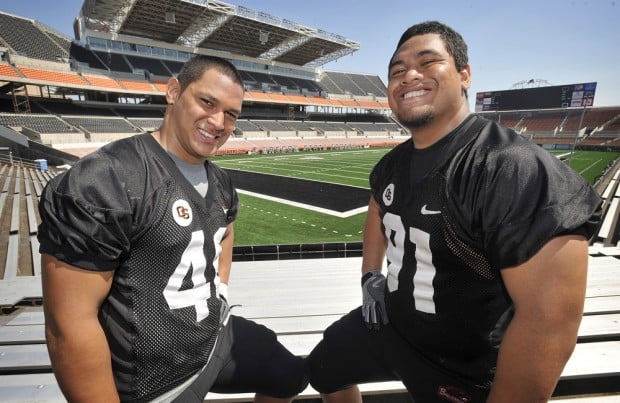
Oregon State freshmen Rommel Mageo, left, and Noke Tago are attending school 5,000 miles from their home in Pago Pago, American Samoa. (Andy Cripe | Corvallis Gazette-Times)

Noke Tago’s first airplane ride was a long one.
A flight between American Samoa and the United States is roughly 15 hours.
If you’re lucky.
Tago said he flew eight hours to Hawaii, waited there for another eight hours and then made the five-hour trip to Oregon.
Tago and Oregon State teammate Rommel Mageo, also from Pago Pago, American Samoa, are both in Corvallis practicing with the Beavers’ football team.
It’s their first time away from home. And home is 5,000 miles away.
“Living a different life, it’s good for me because this is my first time I leave my parents and I stay away from my family,” Tago said. “So the first week I was homesick a lot and I missed my family.”
Mageo’s brother, Natanu, played for North Carolina State two years ago and had the benefit of talking to him before making the move.
“My brother played at N.C. State, so it was a big thing for me,” Mageo said. “He helped me out with a lot of things and he told me all about camp and everything.”
Moving halfway across the world is a big decision.
For Tago and Mageo, it’s a change that they were willing to make.
Few in American Samoa get a chance at college. Or more.
Career prospects are slim at home.
Football is their opportunity.
The American Samoa game
Football was introduced to American Samoa, an unincorporated territory of the U.S., in the 1960s.
While rugby is huge throughout Polynesia, including neighboring Independent State of Samoa, football stuck in American Samoa with the help of television.
The physical nature of the game turned out to be a natural attraction.
“In American Samoa, American football is big,” OSU defensive line coach Joe Seumalo said. “That’s their only form of entertainment.
“They’re raw at the game but they understand the physicalness of it and they love it. They’re no different than a lot of kids over here in the U.S.”
Until Pop Warner started up recently, most of the organized football was played at the high school level.
That means that most players from American Samoa who were good enough to come to the U.S. and play have been raw.
Mageo, a linebacker for OSU, has been playing the sport for five years.
He started in eighth grade.
“It wasn’t really around because we didn’t have youth football. It was only high school, so when you’re little, all you look up to is high school football,” Mageo said. “So when I was in eighth grade I really wanted to play football so I tried out.”
Tago played rugby when he was younger.
A defensive tackle for the Beavers, he’s now 6-foot-1, 290-pounds.
When he arrived in high school the football coaches took one look at him and convinced him to play.
“My freshman year I didn’t practice the whole summer,” he said. “I just come to school and register and the coaches wanted me because they saw me and I’m big. They wanted me to play for them.
“I had more confidence in myself because I played rugby.”
Seumalo said the rules governing football in American Samoa are limited, so the players are able to practice and play year-round.
The players are different as well.
Size is not lacking among the young men of American Samoa.
It’s easy to find linemen and linebackers.
“Football there is different from here,” Mageo said. “There it’s mostly about strength. It’s not really about speed, but everybody’s strong out there.”
The players condition constantly but weight training isn’t common.
Tago said he did a lot of work cutting trees and grass and did push-ups every night before bed.
“We have to do our chores. Every day we do our plantation, grow taro,” Tago said. “That’s where we get our muscle built.”
The recruiting game
Attracted by the size and potential, college coaches have looked for Samoan players for some time now.
Many players of Samoan descent, such as Troy Polamalu, Marques Tuiasosopo and the late Junior Seau, have made the climb to the NFL.
The University of Hawaii has been stocking its roster with Samoan players for years.
Access to the athletes who were already living in Hawaii or on the mainland was simple. Getting to those in American Samoa is a different story.
Film has often been used to evaluate the players.
Recruiting trips to American Samoa have always been tough for college coaches.
“Everyone knows about American Samoa, it’s just that you have flights that are limited, so if you go there, expect to stay there for a couple days because the next flight is three or four days later,” Seumalo said. “And in Samoa, you could probably do it one day, you could do all your reruiting in one day there. But with NCAA rules, these are the dates you can go out and if you go there, you kind of lose a couple days by being out there.
“We just have to be smart in how we do it.”
While there is a good group of American Samoan players who made the trip to the U.S. to play football this fall as freshmen, most of them went to junior colleges.
Four received full-ride scholarships from Division I teams.
Tago and Mageo were two. The other two are Robert Barber and Destiny Vaeao of Washington State.
“Coming here, it’s a big deal, so it was a big thing on the island,” Mageo said. “It was all over the newspaper and everywhere.”
OSU can provide the education and the base for a future career.
“It’s a way for us to get in and get some of those kids and develop those kids,” Seumalo said. “Because you can count the amount the kids that have grown up in the islands, whether it be Samoa or Tonga, that have made it here and played the game of football.”

Friday, May 4, 2012

In American Samoa, football's already the next big thing


When a U.S. football team begins competition in the Under-19 World Championship tournament next month at Burger Stadium, it will begin play against what will likely be a wide-eyed team of teen-agers from the South Pacific islands of American Samoa.
America needs no introduction to Samoa.
American football coaches, anyway.
For years, they've beaten a path — or rather, taken the 11-hour flights from the West Coast — to the small U.S. territory that's about the size of the Washington D.C. metropolitan area. Prominent head coaches like Urban Meyer and Mike Bellotti have made their way from their previous jobs at Utah and Oregon to the five volcanic islands that make up American Samoa to scour them for hefty linemen and physical defenders to supplement their rosters.
Oregon State just signed a linebacker and offensive lineman from American Samoa. Washington State picked up a nationally recruited tight end from there who had once committed to Alabama and a defensive lineman. About half of Hawaii's roster includes players that come from American Samoa lineage.
"Football's like a meal ticket off the island," said Hawaii middle linebacker T.J. Taimatuia, a redshirt sophomore who was born in Fagasa, American Samoa, but played his high school ball in Artesia, Calif. "It's either the military or football."
Just three weeks ago, the Marines swore in 30 teen-aged Samoan recruits, and dozens more consider the Coast Guard, Army Reserves and two Army engineering units. Otherwise, they have to try to find work at the local Starkist tuna cannery, the only one left after the Chicken of the Sea factory closed in 2009 and eliminated 3,000 jobs.
The unemployment rate for a country of about 60,000 stands at 30 percent and rising, according to Mel Purcell, a quasi-general manager for American Samoa's Under-19 national team.
"Football is opportunities," said Purcell, whose three sons all played the sport, one of them a former Hawaiian player who was drafted by the Cleveland Browns, and another a Penn State linebacker. "Football is an avenue to leave home, get a better education and get to the next level. The NFL is really icing on the cake."
Go through any Pac-12 roster, said Hawaii assistant coach Tony Tuioti, who leaves for a recruiting trip to New Zealand and Australia on Thursday, and "there'd probably be at least 10 players minimum of Samoan descent." And Samoan players are starting to pop up in the SEC; Tuioti said Hawaii recruited a Samoan guard who ended up signing with LSU.
Football first came to American Samoa in the 1960s, when ex-Washington Redskins linebacker Al Lolotai, a former pro wrestler in Hawaii, brought the game to his native land and NFL games were later televised on Blue Sky cable. The Samoans took to it like their favorite dish, palusami, which these large extended families serve during huge feasts on Sundays that always included church and the NFL, not necessarily in that order since the games air at 5 a.m. in the South Pacific.
"That's like caviar to Polynesians," Tuioti said, referring to the local delicacy of corned beef and coconut milk with onions wrapped in taro or spinach leaves. "Samoans have such a passion for football. They have the most football players per capita of almost any country. It's like the Dominican Republic producing baseball players."
More than 200 American Samoans now dot Division I college rosters, and 30 have progressed to the NFL, none more famous than Pittsburgh Steelers safety Troy Polamalu. He's immensely popular in Samoa — his parents were born there — and he returned there last year with donations of football equipment and uniforms.
They're also partial to current and former NFL players with Samoan ties, like Chargers and Patriots linebacker Junior Seau, Bengals defensive tackle Domata Peko and Patriots defensive lineman Jonathan Fanene and Raiders quarterback Marques Tuiasosopo, although America Samoa produces very few skill-position players.
By nature as well as body structure and diet, Samoan football players are both aggressive and big-boned. That's one of the reasons American recruiters relish them. They're disciplined and, because they're not always promised three meals, they tend to still be growing.
"A player will come over to the mainland at 6-2, and then he'll be 6-5 and 300 pounds," Tuioti said.
"Samoans like contact. They like to hit things," Tuioti said. "That's why you see most of them on defense, but you're starting to see more and more offensive linemen. We're starting to get some fullbacks because they're similar to linebackers in body type, but we don't have many wideouts that have flat-out speed."
The game played at American Samoa's six high schools leans heavy to the run game. Hawaii running back Joey Iosefa is a converted 190-pound quarterback who played at the island's powerhouse program at Fagaitua High, which again won last season's championship. Iosefa's weight has grown to 240 pounds.
American Samoa also has won six of the last eight Samoa Bowls that pit the island's best team against Hawaii's second-tier players. Coaching clinics are all the rage. A youth football league was formed a year ago. Everything's on the rise.
But American Samoa, as the eighth and last seed in the Under-19 World Championship starting June 30, drew the top-seeded Yanks for its first of three games.
"We have to go up against the biggest giant in football," Purcell sighed.
And if American Samoa springs the upset?
"We'll be able to swim home," Purcell said. "We wouldn't need a plane."

Tuesday, October 12, 2010

Fa’a Samoa-The Mageo Way


In September on CBS's 60 Minutes, correspondent Scott Pelley presented a report, American Samoa: Football Island.  Pelley reported that 30 NFL players and over 200 Division-I players are of Samoan descent. N.C. State senior starting defensive tackle Natanu Mageo is one of those players. 
Raised in Pago-Pago, Mageo started playing football in high school.  There were no youth football programs in Samoa until this past year.  Mageo like other boys grew up playing rugby but could not wait to play football. 
"I always loved football and couldn't wait to get to put on the pads," Mageo said.  "Its part of our culture, everybody wants to play football back home."
In Pelley's 60 Minutes report, he travels to American Samoa and visits with the football teams. On his visit he notices big differences in the conditions in which they played and practiced that spoke to a toughness and passion for the game.  Teams did not have nice fields but dirt and rocks, teams did not all have pads and had to share the old beaten up ones that they did have.  
"We had to share our pads and helmets with the JV team," Mageo said. "For the practices Varsity would get the pads on Mondays and Tuesdays and JV would get the pads on Wednesdays.  They played their games of Thursday and Fridays and we played on Saturdays."
Like many impoverished societies, there are few ways to be successful in American Samoa.  It was planned throughout grade school to either try to go to the states to go to college, or to join the military.  Football became another part of the plan in recent years. 
"You look forward to it, you were expecting to leave the island. Most people go to college or join the military," Mageo said.  "Plan B for me was to go to college and play football. To go to the military was supposed to be Plan A but Plan B presented itself, so I took it."
At the time the only film of games were at the Samoan All-Star game and the Samoa Bowl, played against Hawaii.  With the game footage from these games, Mageo was recruited and given a partial scholarship to play for New Mexico Military Junior College.  After two seasons playing there, Mageo began getting recruited by Division-I schools all over the nation.
Recruiting Coordinator and Special teams coach Jerry Petercuskie travelled to Roswell, N.M. to visit with Mageo.  
"We were looking for an older defensive tackle so I started looking at junior colleges and decided to go check him out," Petercuskie said.  "We aren't going to bring in a player without finding out if they can play, if they are smart, if they are hard working and if they are a good person, Natanu was that and more."
Mageo has had to face many differences in his life here outside of football, experiencing a kind of culture shock being 6,900 miles from home.  
"In our culture, everyone is real respectful to others, it's a whole different world," said Mageo.  "Back home you can rely on each other and be more open with people but over here you have to rely more on yourself and that's how you survive."  
Mageo also had never spoken fluent English.  Growing up he learned English in class but spoke Samoan outside of it and in New Mexico there were other Samoans who he could communicate with.  At State he has had to adjust to a lack of that communication.  
"Its difficult because I think Samoan.  When someone speaks to me it gets translated into Samoan in my head and I have to think before I reply in Samoan," Mageo said.  "I adjusted by not being able to speak Samoan to anybody." 
The only time Mageo speaks Samoan now is once a week during his calls home.  Mageo's last time home was during the break between the holiday break last year.  Visiting right after the largest earthquake of the year hit and caused a tsunami that devastated American Samoa, just two months before. 
"It was right after practice and I had a lot of text messages telling me to call home and asking how my family was doing.   So I ran to the training room and had them turn to the news," Mageo said. "I had never been worried in my life before then.  I thought it was the safest place ever but when I talked to my cousins they said that's where the tsunami hit the worst, in my hometown.
"The next day I got a call from my auntie and she said my family was ok but at the same time a lot of people still died.  It was a hard time and when those kinds of things happen, the only thing you wish for is to be with your family. All I could do was hope and pray for the best."
A major focus in the Pelley piece is in regard to the tough nature and strong culture of the Samoan people.  In his report he interviews Troy Polamalu, perennial Pro-Bowler and Super Bowl winning safety for the Pittsburg Steelers, who is of Samoan descent.  Polamalu spoke of Fa'a Samoa, translated "The Samoan Way."
"It is Samoan culture, Samoan tradition," said Mageo.  "The Samoan mentality is that you are supposed to be tough."  It's not only people's expectations but it's my mentality when I play because that's how I was brought up." 
A criminology major due to graduate this May, Mageo carries Fa'a Samoa with him off the field as well, hoping his education here at State will not only provide him with a chance to play football, but also give him a valuable education that hopefully leads him to a job.  
"I'm trying to get my degree and do something with it," Mageo said.  

Worth More Than A Super Bowl

Years ago on the island of Pago Pago, a little boy by the name of Shaun Nua trekked through the fern, banyan and Aoa tree-filled tropical rain forest of Samoa with his father and uncle while hunting wild pigs for their family dinner. Years later, this same boy would leave the jungles of his homeland and strap on a helmet and wear the blue and white of BYU, changing his life forever.

It was a day Shaun Nua will never forget. As a young boy, he and his uncle used a rope to catch the back leg of a frantic wild boar. Scared and in panic of what was to come, Nua knew the pig had to be restrained before being killed. Hearing the commands from his uncle, Nua was hesitant but wanted to be obedient and not disappoint. Unfortunately before he could reach the pig, it loosened its bond and ran screaming straight towards a paralyzed Shaun Nua standing with eyes wide open. With a hard thud, Nua was knocked backwards to the ground and began to cry. It was a long time from that day to the day he put on a football helmet with a Y logo on the side.
"No, I never dreamed I would be where I am now," said Nua with a large smile on his face. “I was just a little kid from the islands and never dreamed that I would one day play football over here at BYU. My passion for football brought me here to BYU and it's since taken me to other places."

After spending three years at BYU as a defensive lineman, Nua was drafted in the seventh round by the Pittsburgh Steelers in 2005. While suited up as an NFL player, he reached the pinnacle of what he believed life could afford.

"Here I am a kid from Samoa playing in the biggest football arena in the world,” said Nua, who spent three years with the Steelers. “I was living what I thought was my dream."

During his rookie year, Nua would be part of a team that beat the Seattle Seahawks to win the Super Bowl.

"I had reached my final goal," said Nua. "I won a Super Bowl my rookie year and thought, 'Man, is this it?' It wasn't what I thought it would be when I was a kid. I mean, I was on the field and on the sidelines as an NFL player and we won a Super Bowl. It just wasn't what I thought. When it was all said and done, it really helped me to see what BYU was really all about."

Growing up on the island of Samoan, Nua and his family didn't have much and lived off the land like most Polynesians do. After a three-year stint in the NFL and a Super Bowl victory, the dream Nua once had was non-fulfilling and unsatisfying.

"I learned that money will not make you happy, that fame is overrated and it makes you forget who you are and where you come from," said Nua with a serious tone. "It made me realize that there was something more valuable out there than fame, money and football. Man, it made me think and finally realize all those things that Bronco Mendenhall had been teaching me when I was a player at BYU. It finally all came together."

In time Nua would eventually make his way back to BYU as a general assistant coaching on the offensive side of the ball. He was switched back to defense after Coach Hill was fired after the fifth game of the 2010 season. Nua is happy he is back on the defensive side of the ball, where he can now coach a team he once played for and loves.

"I learned a lot from Coach Anae and Coach Weber, but man, now I feel like I'm back home coaching on defense," Nua said. "I'm happy I'm back. Now it's basically kicking this defense's butt every day and trying to help out the d-line with the knowledge I gained from Pittsburgh. I'll help Bronco and Coach Kaufusi with the nose tackles and d-ends. We have good kids and I love these kids. They're learning just like I did when I played here."

While on the Steelers, Nua was learning and competing in football at a higher level. He was a professional playing among and against some of the best talent around. His position coach John Mitchell had 18 years of NFL experience, ranking him the longest-tenured member of the Steelers coaching staff. During his time with the Steelers he learned a lot, and has carried that knowledge with him.

"[The Steelers] run a 3-4 defense and BYU runs a 3-4 defense,” said Nua. “It really gave me a lot of knowledge on how things should look and how things should be done. Man, I learned a lot and Pittsburgh would be the first to tell you that they don't have all the answers to shutting down offenses, but there is hard work and fundamentals and that's what BYU is trying to do. With the knowledge that I gained there, it will help me here and hopefully we can go forward. I think it's a big advantage on my part and now I just have to take advantage of that and be unselfish with that and pass it on."

When Nua returned to BYU to coach as a G.A., his path would take another unexpected turn. On September 29 this year, Nua entered the waters of baptism and joined the Church of Jesus Christ of Latter-day Saints.

"It's been nine years since the time I first stepped foot on campus to the day I got baptized," said Nua. "What influenced me was I wanted to be happy. When I left for the NFL, I was happy but I wasn't completely happy. Something was missing inside. I'm not bashing on any other church and think all other churches are good, but I just felt peace and happiness in this church. It took a long time, and it wasn't like I wasn't happy with my old church – I just felt more comfortable with this church and I believe in it. When I finally investigated the Church on my own, I realized things were different and saw for myself the fullness. Before I wasn't complete and right now this is the most complete I've ever been.

"When I first came here to BYU, I came here for football, but what I found was something bigger. My path is kind of funny and I definitely found something bigger than just football through BYU. Now I'm coaching here and I love being around these kids. One day I would like to take everything I've gained from this experience and go back home to Samoa someday and help the little kids live the dream I once had."
While playing for the Cougars, Nua grew very close to Jim Hamblin, a staff member at the Student Athlete Academic Center. After deciding to join the Church, Nua asked Hamblin to perform the baptism.

"Hamblin and I've been friends since I was here," Nua said. "If you go to his office and sit there the whole day, it's like a therapy session. You'll see members of the Church, non-members, white people, black people, Tongans, Samoans, Fijians, and all kinds of people will be in his office. He never forced me to become a member, but if I had a question he would answer it. He's a good friend and a good person and when I asked him to baptize me, he answered the call. He's a great-hearted guy and helps out all the kids from all sports. I wouldn't have wanted anybody else to baptize me."

Nua also chose to have others that influenced him at BYU participate at his baptism.

"Coach Reynolds gave me the gift of the Holy Ghost," Nua said. "He's another special man and a great influence. With Coach Tidwell, it was kind of a last-minute thing, and I was thinking, ‘Who better to give the talk on [baptism] than the person that brought me here?’ Coach Tidwell is the one that found me and recruited me, and so I picked him to give the talk on baptism. He's a great man and it's really because of him that I'm even here."

Meanwhile, Nua chose to have Kelly Poppinga give the talk on the Holy Ghost at his baptism.

"Kelly Poppinga is another person that I worked with and answered a lot of my questions," Nua said. "Last year when I was a G.A., we both would stay up late talking. We would get up early and talk some more. I had so many questions and he became a close friend of mine is one of the best friends I've ever had."

Many of Nua’s family members and friends went to his baptism. BYU president Cecil O. Samuelson was even in attendance.

"I didn't think there was going to be that many people there because it was such short notice," said Nua. "My parents made it here from back home in Samoa, and there were just a lot of people that was there. It was better than winning the Super Bowl. I was happy and I was on cloud nine and it's hard to explain. I wouldn't trade it for any Super Bowl ring and would give it away in a heartbeat to find what I've found.

"In fact, I did give my Super Bowl ring away to my dad the first day I got it," continued Nua. "I really don't care about things like that and would never trade this experience at BYU and joining the Church for anything in the world. A Super Bowl and a ring is something you can give away, but this experience is something you just can't trade for anything. There is no comparison between being baptized into the Church and winning the Super Bowl. I wouldn't trade being baptized for any Super Bowl ring. I'm really happy now. There is not even any comparison to finding the true religion. There is nothing even better than that." 

Full Article

Tuesday, September 28, 2010

Troy Polamalu and American Samoa - Message to the Players


This is Troy Polamalu's personal message to the football players of American Samoa. This was recorded on August 16, 2010 and was shown in American Samoa when we delivered the Nike gear to the players. It was rebroadcast on local TV and radio.

 Video courtesy of "Troyfortythree"

Friday, September 24, 2010

Fono Commends Troy Polamalu For $100K Football Donation

As a demonstration of their gratitude, all seven high schools assembled at the Veterans Field, wearing their new uniforms. Once again, the whole group burst into song. It was amazing.

A Siva Tau dance by Marist High School on American Samoa. They performed it for us when we delivered the Nike gear to their school on behalf of Troy Polamalu. These kids have great heart.


At the end of our formal presentation of the Nike equipment from Troy Polamalu, the Director of Education and the Lt. Governor of American Samoa led the assembled group in two beautiful songs. Many of the Team Polamalu members were deeply moved by this tradition.

Deutsch Nu'uelua Pu'u, one of Troy's fans on facebook, tells us about the lyrics and meaning of the songs:

Ua fa'afetai ua fa'afetai
ua malie mata e va'ai
ua tasi lava oe
...ua tasi lava oe
i lo'u nei fa'amoemoe

We are thankful, very thankful
we are pleased by what we see
your are the one
you are the one
That we have been praying God Blessed

Note***
This song is a direct "thank you" from the players and all parties involved. The old song is a story of how grateful everyone is of the things this Son of Samoa has done for his Home.

second songs says:

Ua so'ona olioli nei
lo'u loto ia Iesu
ua ia fa'aola ia te a'u
O la'u lea pese fou

I am so very happy
My soul rejoices you Jesus
you saved me
this is the new song that i sing

Pese (Pese, Pese)
Aleluia (Aleluia)
O le La (O lou agaga oe)
Iesu o le fa'aola mai
ua 'ou 'oli'oli ai

Singing (singing, singing)
Hallelujah (Hallelujah)
Your like the sun (you're the light of my life)
Jesus you have saved me
this is the new song that i sing

Note***

The first Song was a "Thank You" song to Troy and team Nike, The second song was to God for blessing Samoa through the hands of one of his own Children.

I must imply that Samoa is a very Christian based land. In Samoa you will not be able to go five minutes in any direction and not see a Church. Hence Polamalu's Christian Background being as strong as it is. All businesses are closed on Sundays at least until Church is complete. It is not a Law it is respect the Samoan People have for God. Samoa is a state where Religion and State ARE NOT DIVIDED! The motto for the American Samoa Government is "Samoa Muamua Le Atua" (Samoa God is first) And for the neighboring Island of Independent Samoa theyre motto is Fa'avae i le Atua Samoa (God be the Foundation of Samoa).
 
 Courtesy of "Troyfortythree's" for the Youtube footage!  

Professional football player Troy Polamalu, whose long curly hair has been insured for $1 million has been commended by the Fono for his contribution to local athletic development through his contribution of $100,000 worth of football equipment.

Last month the football gear was presented to Lt. Gov. Faoa A. Sunia, who was accompanied by Education Department director Dr. Claire Poumele. It was made by Nike Sports Marketing Manager Forrest Sherman on behalf of Polamalu, who plays for the Pittsburgh Steelers.

For his generous contribution, a House Concurrent Resolution was approved this week by the Fono conveying sincere gratitude and appreciation to Polamalu, who the resolution says “is a household name in homes across the United States and American Samoa, especially those homes which enjoy...football.”

Original sponsors of the resolution are Manu’a lawmakers, House Vice Speaker Laolagi F.S. and Reps. Fetu Feui Jr. and Talia Fa’afetai Iaulualo. Later the House amended the resolution to include all members of the House as co-sponsors.

According to the resolution the name ‘Troy’ was chosen by his modest mother Suila ‘Sue” Polamalu-Fiame of Ta’u, Manu’a, “for her youngest son, who mirrors his mother’s modesty as an adult.”

The resolution outlines personal information about the now 29-year old NFL player, who was born in Garden Grove, Calif. and his mother raised Troy and his brother and sisters on her own.  When Troy was nine years old, his mother took him and his siblings to visit her brother in Oregon.

“Troy truly enjoyed the town of Winston where his uncle Salu lived. It was a small community of people who knew each other well,” the lawmakers said in the resolution.

It also says that Troy’s mother and his uncles — former Sen. Fa’amausili Pola and Salu Polamalu — were instrumental in Troy’s “rise to fame.”

“Together they nurtured, encouraged and pushed him to utilize his God-given talents with humbleness and hard work,” according to the resolution, that adds Troy’s athletic talents began to exhibit in school where he was outstanding in baseball, basketball, and football.

Upon graduating from high school in 1998, Troy entered the University of Southern California and in hopes of learning more about his Samoan culture, he joined Polynesian clubs on campus.

The resolution outline several information during his football career at USC, where he “redshirted” his Freshman year and was a substitute safety and linebacker the following season.

Some of his football achievements at USC includes having been voted team captain; earned First Team All-Pac 10 Honors; named a 1st Team All American. He led his teammates with the most tackles since 1986, named USC’s first All-America’s Safety and voted the team’s Most Valuable Player.

“Troy graduated from USC, leaving a legacy of 278 tackles, 6 interceptions, 13 pass deflections and 4 blocked punt,” the measure says.

In his professional football career, Troy began in 2003 with the Steelers and his “diligent hard work with the Steelers won him two Super Bowl Championship in 2006 and 2009” and he’s been named to five Pro Bowls as well, according to the resolution.

It also noted the important and useful donation of over $100,000 worth of football equipment through his association with Nike which was shipped to the territory for local high school football players and coaches.

“The NFL-quality of the equipment has instilled a sense of pride in the athletes and Troy’s inspirational message positively boosted their morale for the entire season,” according to the Manu’a lawmakers.

“...the encouragement of those who traveled thousands of miles to present the equipment demonstrates the confidence that Troy and many others have that our children are destined for great futures if they work hard, remembering their Samoan heritage and not just themselves,” the lawmakers observed.

“The people of American Samoa commend and congratulate you, Troy, on your amazing accomplishments during your young life,” the approved resolution states. “You, along with Samoan athletes of the same NFL caliber, have continually brought your Samoan people to center stage.”

“...the Legislature of American Samoa, for itself and on behalf of the people...of American Samoa, expresses its gratitude and appreciation to you Troy Polamalu for your generosity,” the resolution concludes.


Full Article

Saturday, September 11, 2010

Q&A w/ Rebel's Isaako Aaitui


When UNLV senior defensive tackle Isaako Aaitui first came to the United States from American Samoa in 2006, he spoke little English, knew nothing about Las Vegas and was still learning how to play football.
But Mike Sanford, then the Rebels' coach, saw enormous potential, calling Aaitui a "young Junior Seau."

The 6-foot-3-inch, 315-pound Aaitui, who grew up in Western Samoa, has blossomed into one of UNLV's top players and leaders.

Off the field, Aaitui -- who has two brothers with special needs -- volunteers for Opportunity Village.
Aaitui, whose Rebels (0-1) play at No. 20 Utah (1-0) at 1 p.m. PDT Saturday, spoke to the Review-Journal:

1. What was the experience like when you first began to play football?

I looked like a kid who had no idea what was going on. My high school coach wanted me to be a punter and a field-goal kicker. But he thought of the size and potential I had and put me at defensive end, and in the first game I had five sacks. I don't know how that happened. I had no idea what a great game was. I was just going after the guy who had the ball.

2. Did your coach want you to be a kicker because you were a rugby player?

Yes, I played rugby in Western Samoa. I was like 200 pounds, so they saw me as a kicker and a punter. I was thin, a little bit taller -- 6-4. But now I'm 6-3. I think I had too much weight after that. It brought me down a little bit.

3. What did you think when UNLV recruited you?

I had no idea about scholarships. I didn't have a lot of money. So when they showed up, I was like, "What do I say now?"

4. Did you know much about Las Vegas?

I never heard of Las Vegas. On my recruiting trip I thought, "Man, I have never seen a city like this in my life." I didn't know what to expect. I didn't know it was Sin City and the most famous city in America until a couple of years ago.

5. Why did you choose UNLV?

The lights of Las Vegas got my attention, and I wanted to stay here. I thought, "This is it. This is my dream."

6. How difficult is it to be so far from home?

It's hard. I think a lot of Polynesian kids feel homesick. I haven't seen my family for six years. I haven't been back since. ... Last year when the island got hit by the tsunami, it was really tough, and that's when we played Reno. I called back after the game, and they said they were fine. It's so expensive (to travel back). That's a big issue for me. We would have to pay a fortune to go back home.

7. How long did it take you to feel comfortable speaking English?

It took me one year, although I still mumble sometimes. No one translated to me. I just figured it out.

8. Was it difficult to learn the playbook and understand coaches' signals?

It was really tough. I asked some of the seniors how they learned. They learned it by walking through the plays. The most important thing is to know every position in the defense ... what they're going to do and what you're going to do.

9. How satisfying is volunteering at Opportunity Village?

I love visiting and talking to the kids. I have two brothers who kind of have the same problem. I (would be) glad to go back and serve them after I graduate. I love to help.

10. How important are your brothers to you?

I've got to do things that make them happy. When I was in the seventh grade, my mom passed away and I was the oldest in my family. My brothers looked up to me. The thing I still carry in my heart is to help.

Full Article

Thursday, April 8, 2010

Boyblue Aoelua Receives Promotion

Boyblue Aoelua received a promotion this spring.

The New Mexico State Aggie junior went from special teams player in 2009 to starting middle linebacker candidate in 2010.

"Big difference," Aoelua said following Wednesday's practice at Aggie Memorial Stadium. "Last year, I just played on special teams. Now, I've got to know where everyone's lined up and their assignments. It's kind of like being the quarterback of the defense. It's not an easy task. But it's fun."

NMSU head coach DeWayne Walker said he's been happy with the play of the 5-foot-10, 217 pound linebacker from American Samoa.

"He understands his assignments this year," Walker said. "He knows when to kick our tackles over or when to get us in another defensive front. So far, I've been pleasantly surprised with Boyblue."

2009 (Sophomore): Aoelua played in nine games for NM State in 2009 on special teams. He tallied two tackles on the year, one coming against Prairie View A&M (9/12) and New Mexico (9/26). 

2008 (Freshman): Aoelua played middle linebacker and on special teams for the Aggies in seven games in 2008 before suffering a season-ending injury. On the season, he tallied six tackles and a fumble recovery. Aoelua recorded three straight games with two tackles against New Mexico (9/27), Alcorn State (10/4) and Nevada (10/11).

High School: He was the Fagaitua High School starting linebacker for three years, helping his team to three straight island championships in 2003, 2004 and 2005, finishing as the island runner-up in 2006. He and Fagaitua High School posted back-to-back undefeated seasons in 2004 and 2005. He was a first team All-AHSS selection during his junior and senior seasons. In his senior season, he recorded 64 tackles, six sacks, two interceptions and five fumble recoveries. He also played in the Samoa Bowl in 2005 and 2006 and was named to the AHSS All-Star team both years. He was also a member of the Honor Roll all four years of high school.

Personal: Aoelua is the son of Solmio and Auga Aoelua.  He is majoring in geography.

Thursday, February 11, 2010

Bengals' Rey Maualuga Looks to Turn Life Around

ESPN's Adam Schefter has reported that Cincinnati Bengals linebacker Rey Maualuga will enter the Betty Ford Center in Rancho Mirage, California for at least 30 days once he returns from his trip to Samoa. He is traveling with teammates Domata Peko and Jonathan Fanene to visit areas that are still struggling after last year’s tsunami. Maualuga is expected to finish the treatment in time before the team begins their offseason conditioning program on March 29.

Last week, Maualuga pleaded guilty to DUI charges after he was arrested in northern Kentucky January 29 after he hit a parking meter and two parked cars. The former USC linebacker had a blood alcohol level of .157 after police reports indicated he had drank six Captain Morgan and Coca Colas. He received a suspended seven-day jail sentence and two years' probation along with a 90-day suspension of his driver's license.

While the actions of Maualuga will hurt the reputation of the Bengals as a team trying to lose their image as a team filled with players who constantly get in trouble with the law, there is a positive to the recent incident.

As an individual, Maualuga has realized the mistake he made and is taking the right approach to prevent it from happening again. There is so much potential for him after he played such a key role in Cincinnati’s defense this season and the Bengals should be happy he’s willing to turn his life around.

Between his jail sentence and time at the alcohol treatment center, Maualuga should be a different person by the time Cincinnati begins their offseason conditioning program at the end of March. If anything, this incident may have been a blessing in disguise if he can learn from it all and become not only a better person, but player.

The Bengals selected Maualuga with the 38th pick in last year’s draft. His season was cut short after suffering a fractured ankle in Week 16 against the Kansas City Chiefs and was a major reason behind the success of Cincinnati’s run defense. He started 15 games and finished his rookie season with 63 tackles, one sack, and three forced fumbles.

Full Article

Friday, February 5, 2010

Journey to Samoa

Cincinnati's Local 12 is joining the Cincinnati Bengals for an away trip ... far, far away ... to Samoa!

Local 12 Sports Anchor Tara Pachmayer joins Bengals players Domata Peko, Jonathan Fanene and Rey Maualuga on their journey to Samoa, the South Pacific Island where they grew up. The five-day coverage event begins Sunday, February 7 after the Super Bowl.

The trio is on a mission of goodwill, visiting their community devastated by a tsunami last fall. Local 12 will be there as the players are reunited with family and friends, and provide much-needed aid to the island they love. Local 12 has agreed to share their experiences from Samoa with bengals.com, so be on the lookout for the first reports next week. 

"They’re really excited," Peko said. "I’ve talked to a lot of my family and old friends and they say the island is so excited. They can’t wait to see us and we can’t wait to see them.”

Local 12 will take a look at their football roots and trace the footsteps that led them to the Cincinnati Bengals.

“I actually think this is going to be an extremely emotional trip for the Samoan Bengals," Pachmayer said. "We see these guys as big, tough and strong, but they haven't seen their homeland since its devastation, and they haven't yet seen the faces of the people they are going to help.”

Full Article

Tuesday, February 2, 2010

Don't Count Out The Nation of Tonga for Football Talent


The decision by Harvey Unga looms big for not only himself and BYU, but the latest generation of football players with roots and ties to Tonga.

You may have tuned into CBS' 60 Minutes last Sunday and viewed the fine piece on American football in Samoa. A few hundred miles to the south is the Friendly Islands of Tonga, which has far greater potential than Samoa for providing football players to U.S. colleges and the NFL.

American Samoa has a population of about 60,000, if I recall the figures mentioned in the CBS piece. There are 260,000 Tongans in the world. During a lunch this past week, I discussed this with Timani Tonga, whose family lived with my family at Liahona High School near Nukalofa, Tonga in the 60s.

Timani's cousin is the father of Manase and Matangi Tonga, both recruited by BYU out of the San Mateo area in northern Calif.

Timani told me Tongan athletes have favored BYU as a choice for several generations, it just seemed to be the place where many sent their kids when they migrated to Laie, Hawaii to attend school. It was a church thing. But it's getting harder for BYU to expect that kind of loyalty with other recruiters making solid pitches with promises to take care of their sons. Rival Utah has been extremely successful recruiting Tongan players since Ron McBride made it an emphasis. If you look at Pac-10 schools, Polynesian players, Tongans in particular dot the rosters at USC, UCLA, Oregon, Oregon State, Washington, ASU, Arizona and other schools.


It's a unique dynamic. Many of the Tongan players on BYU's team, guys like Harvey Unga, Manase Tonga, Fahu Tahi, Fui Vakapuna and others grew up in the United States. Same for Utah D-coordinator Kalani Sitake, who grew up in Missouri. Only a few, like the generation of BYU defensive line coach Steve Kaufusi have actually lived in Tonga. Kaufusi returned to Tonga to serve an LDS mission. There are five Tongan LDS stakes in the U.S., three of them are located in Utah and two in California.


According to Timani, it is the only ethnic group in the LDS Church that has specific status in stakes. Other ethnic groups may have branches or wards that are of a specific ethnicity, but the Tongans carry a very unique role in the church when it comes to these stakes.

According to Timani, who worked in the Tongan government as an accountant and also served in many LDS leadership roles in the Islands, of the 260,000 Tongans, 140,000 live outside Tonga, a country that boasts at least 18 LDS stakes. Timani said 52 percent of all Tongan are LDS.

Harvey Unga's parents come from the Island of Vava'u in Tonga and are tied to the Unga and Langi name line. Most all Ungas and Langis are related through this line.


That Harvey Unga could possibly return, get a degree and become one of only nine college players to ever rush for 1,000 yards for four-straight seasons is a big thing for Tongans because it sets a solid example for the others who may choose the Cougars, Utah, USU, SUU or other FSB programs. Haloti Ngata, a Tongan who starred at Highland High before going to Oregon and then the NFL is also a huge inspiration for his countrymen.

---

Several Pac-10 schools out of the College of San Mateo heavily recruited Matangi Tonga, expelled from BYU after being involved in law-breaking activities as a freshman. He was offered by ASU's coaching staff but according to reports, the administration intervened and refused to allow Matangi a scholarship. He will enroll at Houston.

According to sources, former BYU safety Shiloah Teo, a Samoan, will enroll at Washington and play for Steve Sarkisian. I haven't seen his list among Washington 2010 recruits. He may have already enrolled as a mid-year player.

---

Today, BYU football spokesman reported the following athletes will not be available for spring football:

The following players have had or are scheduled to have post-season surgery: senior defensive back Andrew Rich (ankle), sophomore defensive back Robbie Buckner (shoulder), junior offensive lineman Marco Thorson (shoulder), sophomore offensive lineman Braden Hansen (thumb) and freshman wide receiver Ross Apo (shoulder).

Rich, Buckner, Thorson and Hansen have already undergone surgery for injuries sustained during the 2009 season, and Apo is scheduled for surgery this week to treat an injury suffered in high school.

Hansen is probable for spring practices, Rich and Buckner are questionable, and Thorson and Apo will be out for spring. All are expected to participate in fall camp.

Full Article

Thursday, January 28, 2010

Lofa Tatupu donates $10,000 to USA Football for Youth Football in American Samoa


USA Football, the sport’s national governing body on youth and amateur levels, announced today that Seattle Seahawks linebacker LOFA TATUPU has donated $10,000 to the independent non-profit to assist in its work of establishing American Samoa’s first youth football program.  With USA Football’s financial assistance, bolstered by Tatupu’s gift and support from Riddell, youth football is being played by youngsters aged 11-14 on the island territory for the first time.

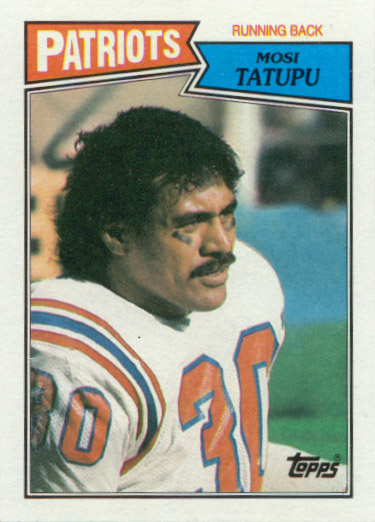
Tatupu is the son of MOSI TATUPU, the first native-born American Samoan selected to an NFL Pro Bowl (1986) as a fullback for the New England Patriots. The younger Tatupu’s pride in his American Samoan ancestry and respect for the island’s people and their affinity toward football compels him to further strengthen the sport there.

Since 2008, USA Football has worked with American Samoa football leaders to establish organized youth football on the island, providing the latest equipment and USA Football’s coaching education resources to serve the new league’s volunteer coaches. USA Football is the official youth football development partner of the NFL, the NFLPA, and the league’s 32 teams.


Tatupu’s gift will be presented by his father, Mosi, to USA Football Executive Director SCOTT HALLENBECK prior to kickoff of this Saturday’s USA Football “TeamUSA vs. The World” game, presented by Riddell, in Ft. Lauderdale. The 12 p.m. ET game, aired live by NFL Network, features 90 of the world’s best high school-aged football players spanning four continents. Mosi Tatupu is an honorary captain for the World team which has three American Samoa natives on its roster.

Comprised of 77 square miles with 65,000 citizens, there are more than 30 players of Samoan descent in the NFL and more than 200 playing Division I college football. In the past five years alone, the island's six high schools have produced 10 NFL linemen and it is estimated that a boy born to Samoan parents is 56 times more likely to play in the NFL than one born in the United States.

“This is an island and a culture centered around family,” said Lofa Tatupu. “There is a strong sense of togetherness, respect for others, sacrificing for the good of the family, and teamwork woven into American Samoan life – these are the very same values found in successful people and winning football programs.

“These kids deserve a shot, an opportunity. I thank USA Football and everyone who has had a hand in helping American Samoa’s kids enjoy this sport in an exciting way that they’ve not experienced before this year.”

About USA Football
USA Football, the sport's national governing body on youth and amateur levels, hosts more than 80 football training events annually offering education for coaches and game officials, skill development for players and resources for youth football league commissioners. The independent non-profit is the official youth football development partner of the NFL, its 32 teams and the NFL Players Association. USA Football also manages U.S. national teams within the sport for international competitions. Endowed by the NFL and NFLPA in 2002 through the NFL Youth Football Fund, USA Football (www.usafootball.com) is chaired by former NFL team executive Carl Peterson.

Friday, January 22, 2010

Three Players From American Samoa Will Represent "The World" vs Team USA


American Samoa’s three picks to the International Federation of American Football (IFAF) World Team that will face Team USA in an official Pro Bowl Week event Jan. 30 are thankful for being selected and ready to represent the territory in the match that will air on the NFL Network.

Beck Coulter, 18, Aiulua Fanene, 17, and David Katina, 17, have been named to the IFAF World Team led by Head Coach Jan Jenmert, head coach of Sweden’s junior national football team.

Team USA, USA Football’s 2010 National Junior Team is headed by Chris Merritt, head coach of Miami Christopher Columbus High School.

The teams are set to play Jan. 30 at Lockhart Stadium in Ft. Lauderdale, Florida.

The game features USA Football’s 2010 Junior National Team and a World Select team comprised of players and coaches spanning four continents, says the IFAF. Team USA includes America’s top high school football student-athletes.

Presenting sponsor of the match is Riddell, which provides the official helmet of the NFL.

“Being part of this game is important to us,” said Riddell President Dan Arment in an IFAF media statement issued this week. ”Americans know how football brings people and communities together and the sport has done that for generations...Riddell is proud to be associated with this game and USA Football.”

He says USA Football’s ‘Team USA vs. The World’ game shows “the global passion for football’s excitement and team-first values with athletes and coaches spanning 12 nations.”


Beck Coulter
Current School/Club: Trinity (TX) Community College     
Country: American Samoa
Height: 6-2 | Weight 240 lbs.
#TBD | Position: LB


Beck Coulter, 18, son of Robert (Bob) and Tagiilima (Lima) Coulter of Leone arrived in Round Rock, Texas, yesterday (he returned to Texas Sunday), after spending the holidays on-islan. Beck, an outside linebacker for the Trinity Valley Community College (TVCC) Cardinals.

“I am thankful for the opportunity...I was surprised...I’m just going to play hard to represent our country,” he told Samoa News.

The tsunami of Sept. 29, 2009 happened months ago, yet Beck, whose family lost their home, with relatives having to swim for their lives — dedicates his performance Jan. 30 “to all those who lost their loved ones in the tsunami.”

“May God be with us in that game,” he prays. Beck was in Texas when the tsunami hit. Five days after the tragedy, when the Cardinals played Navarro, his teammates, joined Beck and fellow Cardinal Isaac Puapuaga, to perform a ‘haka’ in honor of the Samoans.

Beck will leave Texas for Florida this week. Possibly three of his family members, including his mom Lima and little brother Cameron Coulter are traveling to Florida for the game.

Beck is a 2009, Leone High School graduate. TVCC, where he is a first-year student, is located in Athens in the Lone Star state. It is a member of the National Junior College Athletic Association (NJCAA). Head Football Coach at TVCC is Brad Smiley, according to the school’s Web site tvcc.edu.

“We’re on a mission to do the best for our island,” said Beck.


Tavita Katina
Current School/Club: Marist High School   
Country: American Samoa
Height: 6-2 | Weight 235 lbs.
#44 | Position: LB


In an interview with Samoa News, yesterday, David Katina, the third child of Pastors David and Debbie Katina, says he was shocked and thankful.

“I was very shocked and very thankful to be selected as one of the top players in the World,” David said, “...ever since I found out about it, I pushed myself to work harder than before because this is a big opportunity for me.”

David is a senior at Kanana Fou High School but plays for Fa’asao Marist High School, led by Principal and Head Coach Victor Langkilde. He played in a number of games for the Cougars throughout the season, and was named the Defensive Player of the Week in the second week of ASHAA football.

He is a defensive end and outside linebacker for the Marist Crusaders and is known for his hard efforts on the field — sacking quarterbacks and stopping running plays behind the line of scrimmage.

“My parents are very excited about it, as well as my brother and sisters,” David said. “I already have some family flying over to Florida to watch my game, and to come see me play”.

Katina says a number of colleges are lining up for him.

He is leaning more toward the University of Hawaii, led by Head Coach Greg McMackin.

“But we had some good offers from the University of Arizona, Oregon State, the University of Oregon, and the University of Tennessee,” Katina noted.

David has been selected to play the Defensive End position, as well as Outside Linebacker for the World Team. He played on American Samoa’s International Team that routed the Australia U-19 Outback Squad 49-6, Jan. 2, 2010.

“I would first of all want to thank our Heavenly Father for his everyday blessings upon me and my family as well as my friends — a special thanks to my parents for supporting me, and for pushing me to become a better individual...to my brother and sisters for being such great supporters during my games.”

He also thanks Ben and Josh of the Langford family, and the Tuiasosopo family.

“I would also like to thank our Kanana Fou High School Principal Rev. Iasepi Ulu and the teachers and coaches for getting me through rough times to where I am now,” David said, “and for teaching me how to be prepared for the real world after I graduate.”


Aiulua Fanene
Current School/Club: Tafuna High School     
Country: American Samoa
Height: 6-5 | Weight 280 lbs.
#TBD | Position: DL


Samoa News also had the opportunity to talk to Tafuna High School’s Aiulua Fanene, senior offensive guard and defensive end for the Warriors. He said he “feels great” about being selected and calls it a “blessing.”

“I feel great, this is an opportunity that most players are looking for, and I guess it was just a blessing to be amongst the best in the World,” said Aiulua who was featured alongside his big brother Jonathan Fanene — on the CBS 60 Minutes segment “American Samoa: Football Island.”

Aiulua is the tenth child of David and Anna Fanene of Nu’uuli and Malaeimi.

He is a senior at Tafuna High School. He was a starting offensive guard for the American Samoa All Star team that beat Hawaii 23-20 in the 2010 Samoa Bowl VII, Jan. 1, 2010.

Samoa News asked Aiulua on the position that he has been selected to play for.

“They are putting me at offensive guard and defensive end,” he said. “I have worked hard ever since I knew about the selection, and I have worked myself into new and better techniques on the line.”

He thanks his parents for their efforts in pushing him to become a better person.

“I want to thank my parents for their hard efforts in pushing me to become the better person, and to teaching me how to be patient and supportive,” said Aiulua. “I also want to thank my teachers in Tafuna High School for pushing me beyond the limit of expectations, education -wise, and to my coaches for helping me work toward my goal.”

David and Aiulua depart the island Thursday for Florida.

Kick-off is set for 12 p.m. Eastern Time. The game will air after AFC and NFC All-Star practices in Lockhart Stadium and both events are free of charge. NFL Network will televise the game.

Full Article