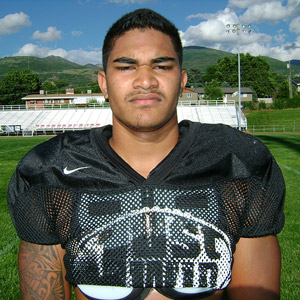
He was the boy who had to sit down while the other kids got to play.
A heart condition, caused by a rheumatic fever infection when he was a 5-year-old in American Samoa, made little Jesse Sapolu stick out as an elementary school kid in Kalihi.
"I was old enough to be embarrassed, not speaking English, but not here long enough to know the territory," Sapolu says. "I couldn't play P.E. all the way to seventh grade, not even kickball. Whenever I got to play, I said I'm never going to complain."
That's why, on the night of Dec. 1, 1979, it could've been easy for Sapolu to call it a career night. Not only had he become a stellar athlete at Farrington High School, Sapolu was an anchor for Hawaii in a 29-17 upset win over nationally-ranked Arizona State.
Sapolu was a true freshman who had played brilliantly on the offensive and defensive lines. Then-UH coach Dick Tomey hasn't forgotten.
"He was very willing to play both ways," Tomey said. "We'd complete a series, I'd wave my hand. Stay in there and play. He was willing to do whatever it took to help."
On the sideline, Tomey chatted in the final minutes with an exhausted Sapolu. They looked across the field at the stunned Sun Devils.
"The game was winding down and I said, 'You could've been over there,'" Tomey recalled. "He said, 'I'm so glad I'm over here.'"
Just months earlier, Sapolu was set to become a Sun Devil before Tomey talked him into staying home. That gave UH an O-line that also featured future pros Kani Kauahi, Jim Mills and Bernard Carvalho, clearing the way for super back Gary Allen.
The season-ending win gave UH a 6-5 winning mark in its first campaign as a Western Athletic Conference member. It was especially sweet because ASU had dumped the WAC the year before to join the Pac-10.
"The first time I met Jesse, we were talking about him going to Arizona State," said Kauahi, who had been at ASU but transferred to UH. "Jesse was a tiger, man. He was an animal."
Hawaii went 8-3 and 9-2 in the next two seasons and earned the respect of pollsters nationwide. Jim Donovan, now UH's athletic director, was a backup on the O-line during that ride.
"Jesse was one helluva offensive lineman, maybe the best ever from Hawaii," Donovan said. "Certainly the best guard-center combination."
Keith Ah Yuen was a reserve tackle-guard when Sapolu arrived as a freshman.
"He came to his first meeting on crutches with a sprained ankle," Ah Yuen said. "Years later, he's back for his second Pro Bowl and he asks me how he's doing. I said, 'You're playing in the Pro Bowl.' But he says, 'I'm asking you because when I came in as a freshman, you were thinking this guy's not going to amount to anything. That's the look you had. I was going to prove you wrong.'"
Sapolu and Ah Yuen were among the few who regularly took on defensive tackle Tom Tuinei at practice.
"Jesse came in and he was cultured, could speak well, but all the Kalihi guys had that competitive, 'hood mentality on the field," Ah Yuen says. "People would be scared to go up against Tom. Jesse wanted to go up against the best. He always tried to line up against Tom."
How did Sapolu choose UH over Arizona State? His mother, Lila, wanted to see her son stay close to home -- no surprise considering the family had already come a long way.
The Sapolus moved to Hawaii from American Samoa after Jesse became ill. By his senior year in high school, though, he had overcome his heart condition and became one of the state's top prospects.
Tomey hit the pavement of Kalihi hard during that recruiting season.
"Dick Tomey came to our home," Sapolu remembers. "Ross (Hannemann), Mufi's brother, had told him, 'You sit on the floor because that's the ultimate sign of respect.' My mom was so shocked, they got out of their seats and sat him on the couch."
On another occasion, Tomey paid a visit on a Sunday morning. Jesse's father, Pa'apa'a, was preaching at Samoan Congregational Christian Church of Honolulu, but Jesse was out of sight.
"It was a good thing and a bad thing," Jesse said. "I'd snuck out to go watch NFL games on TV. My dad was told by my sister that Tomey was there and they called me back into church."
Tomey stuck around, though, for a long time.
"Jesse wasn't in church, but I went to listen to his dad," Tomey said. "It seemed like the service lasted a long time and I'm not understanding what's going on. I'm sitting there in the pew for a half-hour and his sister comes back, motions to me, 'Coach, Coach, we can go in the house now. This is the financial report.' I'm listening there like it's the sermon."
They can laugh about it now, but underneath the misunderstanding was Tomey's diligent approach to recruiting.
"I'm this dumb haole, just trying to be respectful to his family and his dad's church," he said, noting that Sapolu was cautious and patient through the recruiting process.
"He deliberated for a long time. I never take anything for granted," Tomey says. "I just felt recruiting's the lifeblood of football. If you're not out there working, in every single home as many times as you're allowed and making contact, you're not doing everything you can do. That was my feeling. I have so much respect for Jesse and his family."
Players like Blane Gaison, who arrived on campus a few years before Sapolu, had opted to stay and give Tomey a try rather than leave. Among local high school recruits, Tomey puts Sapolu in a category of his own.
"He was the first terrific player to stay home," Tomey said.
Sapolu said it was simply great effort on his coach's part.
"Dick Tomey's a helluva recruiter," he said.
Sapolu did his part, of course. All-WAC honors preceded four Super Bowl rings during the San Francisco 49ers dynasty of the 1980s and '90s.
Even with a monumental pro career, he's quick to rattle off his favorite wins in a UH uniform. The Arizona State win was big, but so was the victory over Colorado State, another game that called for his defensive play.
He remembers the loss to Nebraska. Hawaii led 16-7 in the fourth quarter before falling, 37-16. Wins over South Carolina and West Virginia -- the latter saved on a blocked field goal by Niko Noga -- also stand out.
"We were 9-2," he says of the '81 season. "Ranked 17th in the UPI, 16th in the AP."
Shortly after losing to Hawaii, Arizona State was placed on two-year probation by the NCAA for 30 rules violations. Sapolu seemed to have a knack for picking the right path, even if the road was bumpy early on.
Damien Memorial School offered Sapolu an opportunity coming into high school.
"I went there on scholarship after begging my doctors to relent," Sapolu said.
But the school later learned about his heart condition and wouldn't allow him to play. Then he went to McKinley, but came back to his district school, Farrington, and flourished under head coach Al Espinda, Harry Pacarro and line coach Gordon Miyashiro.
These days, Sapolu is busy with his duties as the 49ers alumni coordinator, and his four children. His only daughter, Lila, played volleyball at Chaminade. Son London recently committed to play football at UH and another son, Roman, plays for Edison High in Huntington Beach, Calif.
"The thing that makes me happy is my kids can understand the impact, to make a name for themselves," Sapolu says. "What people remember is how you treated them off the field. I make time, and if I don't, I make an effort to explain. Without the fans, none of us exist."
EVEN WITH ALL the injuries -- three during his first three pro seasons -- and the constant checkups on his heart condition, Sapolu became an elite athlete in the trenches. At 6-foot-4 and 285 pounds, he was a highly mobile offensive lineman who was an easy fit in the 49ers' West Coast offense.
"Bob McKittrick was their line coach and he liked players that could really move," Tomey says of his former coaching associate, who died in 2000. Tomey and McKittrick hailed from UCLA, and both were ultimate believers in the Crowther, a sled that is still the basis for O-line fundamental technique at many programs.
"Jesse understood that progression and could execute it perfectly," says Tomey, who first came across the unique sled while at Kansas. By the time Sapolu was with the 49ers, he was ready.
"That was something they felt was unique with Jesse. Most college players had not been taught that progression. It takes a long time to learn. Jesse's mastery of it made a difference," Tomey says. "There's a videotape out there someplace of Jesse with the fundamental use of the Crowther that's perfect."
That ability to stay ahead of the pack wasn't new. Sapolu was drilled and disciplined by the time he arrived at UH thanks to Farrington's coaching staff.
"UH was pleasantly surprised at how far along I came," Sapolu says.
Gordon Miyashiro, now at Word of Life, was the O-line coach, and they still keep in touch.
"Last year, the first thing out of his mouth is, 'Jesse, I have a kid 6-4, 6-5, who might be better than you,'" Sapolu recalls. "I said, 'You've said that 14, 15 times.'"
Sapolu, 48, hasn't resided in the islands since his UH glory days, but remains a fixture with serious Q Rating appeal. His appearances in Times Supermarket TV commercials continue. This year, Sapolu, Mayor Mufi Hannemann and former Cincinnati Bengals quarterback Jack Thompson formed the Samoa 'Ioe (Yes) Foundation, aiming to build fields and bring equipment to the island.
ONE ROSS -- Hannemann -- played a key role in Sapolu's decision to stay home and play for UH. Another Ross also became important in his life. In 1997, Sapolu became prominent in medical journals as the first U.S. patient to undergo the Ross procedure, which repaired his damaged left aortic valve and prolonged his NFL career for one final season.
"The doctor said, 'Your heart is like one in an old man,'" said Sapolu, who could've just retired.
Instead, he opted in favor of surgery. His right aortic valve had done virtually all the work and his left valve had enlarged.
The procedure required two delicate steps: replacing the faulty valve with his own pulmonary valve and proximal pulmonary artery; then, replacing the pulmonary valve with a human cadaver aortic valve and proximal aorta.
All medical mumbo-jumbo aside, Sapolu had no doubt.
"It's crazy if you look at it from the outside, but I didn't want kids with the same condition to suffer like I did. You can do the procedure, go back and chase your dream," he said.
Four days after the surgery, Sapolu left the hospital. After one week, his enlarged valve had shrunk. After three weeks, he was running again. Eight months later, each valve was basically normal-sized again, and he was cleared to play a final season.
Full Article