Showing posts with label colorado. Show all posts

Wednesday, September 15, 2010

Cabral Inspires CU`s Hawaiian Players

Brian Cabral
Today  Brian Cabral is a kupuna, a respected elder.

But 36 years ago, the legendary Colorado linebacker and long-time assistant coach was just a wide-eyed kid from Kailua, Hawaii, trying to adjust to college life in Boulder.

"I think for every freshman it`s the same, it`s hard being away from home. The farther away you go from home, the harder it is," Cabral recalled during a recent interview with the Camera. "When people don`t understand you when you`re trying to speak your version of English, we call it Pidgin English, they don`t know what you`re saying. They don`t understand you. The food is a little bit of an adjustment, the culture is a little bit of an adjustment. ...

"You feel like here in the mainland you`re on an island."

Cabral was able to adjust to his new surroundings under the Flatirons and began to thrive.

In 1976, he was a captain on CU`s Big Eight championship team, finishing that memorable season with 13 tackles in the Orange Bowl against Ohio State. He graduated in 1978 and began a nine-year NFL career that included winning a Super Bowl in 1985 as a member of the Chicago Bears.

For many young Hawaiian males, Cabral inspires hope as they attempt to use football to realize their dreams.

"I`m an island guy that left the island to go to college. I`m an island guy that went on to the NFL," Cabral said. "I`m a kid that grew up on the beach and ultimately got to where every football player wants to get to."

On Saturday, CU will host Hawaii at Folsom Field. The Buffs will open up the 2011 season in a rematch with the Warriors at Aloha Stadium in Honolulu.
  
The series means a lot to Cabral, who has always recruited his home state very well and coached some great players from Hawaii, including recent Buff standout Jordon Dizon. The All-American linebacker, who is now a member of the Detroit Lions, used to say hisNo. 1 motivation at CU was "not to disappoint my (position) coach."

Cabral explains what the game of football means to players from Hawaii this way:

"Football on the islands is bigger than life. High school football, Pop Warner football, it`s big. It`s a very physical culture and that`s why they love the game of football. ...

"We`ve brought the right guys to CU. They`re physical players, they love contact, they love the game. That`s why you recruit Polynesian kids, that`s why you recruit Hawaii."

Rainbows to Warriors

Hawaii began playing football in 1920. Then called the Rainbows, the program completed back-to-back undefeated seasons in 1924-25, outscoring their opponents 606-29 -- including a 13-0 victory over CU on Jan. 1, 1925, in Honolulu -- during the 18-game span.

Thomas Kaulukukui
In 1935, Hawaii running back and future coach Thomas Kaulukukui became the program`s first All-American. His No. 32 is the only retired number in the school`s football history. Following the attack on Pearl Harbor during World War II, the Rainbows did not play from 1942-1945.

In 1955, a year after a 50-0 loss to Nebraska in Honolulu, the Rainbows traveled to Lincoln and upset the Huskers 6-0. In 1975, Aloha Stadium -- site of many NFL Pro Bowls -- was built and became Hawaii`s new home field.

In 1992, Hawaii won a share of its first-ever WAC championship and also captured its first bowl game victory, a 27-17 triumph over Illinois in the Holiday Bowl.

"As long as I`ve played here or coached here we`ve never played Hawaii," said Cabral, who wore his lava lava wrap to celebrate his 300th game as a Buff last season during CU`s 35-34 win over Texas A&M.

"We`ve played in Hawaii for a bowl game, but we`ve never played Hawaii. That`s a different challenge. Hawaii has a great history."

More recently, former Hawaii head coach June Jones (now at SMU) and quarterback Colt Brennan (NCAA career touchdown passes leader) led the Warriors to their first outright WAC title in 2007 and an appearance in the Jan. 1, 2008, Sugar Bowl, where they lost 41-10 to Georgia.

"In high school, I did start following the Warriors," said CU offensive lineman Sione Tau, who is from Honolulu. "The Warriors have been doing a lot of good things, so I`m pretty excited about the game, it`s going to be awesome. First of all, to play against friends and old rivals from high school will make it a pretty exciting game. I`ve also heard lot of people from Hawaii are coming in for the game."

Hawaii opened up the season with a 49-36 loss to USC in Honolulu and pulled off a dramatic 31-28 victory on Saturday against Army, 4,995 miles away in West Point, N.Y.

With the WAC scheduled to lose Boise State, Fresno State and Nevada to the Mountain West, there is talk about Hawaii perhaps going independent in football as BYU will next season. Despite the fact that major programs are willing to make the trip to paradise, Cabral believes it would be tough for the Warriors to compete at a high level without a conference affiliation.

"I`m not sure about that. It`s very difficult for them on the islands financially, although the support is very awesome," Cabral said. "Independently, I don`t know the plusses and minuses. Hawaii is a hard place to live economically, it`s a hard place educationally, it`s even harder athletically on a football program."

Hawaii is scheduled to visit Boulder again in 2014 with the Buffs traveling back to Honolulu in 2015.

The next generation

B.J. Beatty
Michael Sipili
Two of the Buffs` best defensive players this season, linebackers B.J. Beatty and Michael Sipili, are from Hawaii. They will see a lot of familiar faces on Saturday, considering the Warriors` 2010 roster includes 46 players from the Aloha State and a handful of others from American Samoa.

"For me and some of the guys from there, it`s exciting. Back when I was home for the summer I was laughing because when I left I didn`t think I`d ever play against anybody from home or anybody that I knew. It`s going to be an exciting event for both teams," said Beatty, a senior from Kaawa, Hawaii. "I never really got into Hawaii football. When I went to high school I knew teammates and guys I competed against who went there, but I really never became a fan. But Hawaii football for the state is always a good thing. There are no professional sports out there, so that`s what they always have to look forward to."

Chris Naeole
Beatty won two state championships at Kahuku High School. Chris Naeole, the former CU All-American offensive guard, is an uncle of Beatty`s on his mother`s side of the family. His father Byron played linebacker at Brigham Young in the late 1980s after a standout high school career on Oahu.
  
"It can get down to the wire. I`ve been in some games where my heart has probably stopped once or twice out there," Beatty said when asked about the atmosphere under the Friday night lights on the islands. "It`s always pound the ball and big heavy dudes. The physical side, coaches never have to worry about us. We love to get physical. We love to come down here and hit each other head to head. It`s always good fun."

Sipili, the Buffs` starting middle linebacker, ran into some serious off-field trouble early in his college career. He pleaded guilty to misdemeanor assault in 2007 for his involvement in an attack on another student and was sentenced to four days on a  Boulder County Jail work crew, 80 hours of community service and two years of probation. CU`s Office of Judicial Affairs suspended him from school for the fall semester that year.
  
Not surprisingly, Cabral didn`t give up on Sipili, who has rewarded his coach by maturing. He will likely have an opportunity to play in the NFL after graduation.
  
"Coach Cabral helps so much. He is a big influence in my life," said Sipili, who grew up in Honolulu. "He has been a big help and support for the guys who come from the island. He makes it more comfortable for us to be here. ...
  
"He has always been by my side and he has always told me to take my mistakes head on and move forward. You can`t do anything else but move forward."
  
Freshman outside linebacker Kaiwi Crabb, also from Honolulu, is the fourth current Buff from Hawaii. Even though CU`s current head coach is on the hot seat after a miserable 52-7 loss to future Pac-10 foe Cal, Cabral -- who lettered three times for Bill Mallory and has worked for Bill McCartney, Rick Neuheisel, Gary Barnett and  Dan Hawkins -- will likely be there to mentor Crabb throughout his collegiate career.
  
"I made the same trip, I took the same plane over the ocean and stepped onto the mountains. I understand the transition, I understand the culture, I understand where they`re coming from," Cabral said. "That has been fun for me. One of the reasons why I do like bringing kids from Hawaii is to give them the same opportunities and experiences that I had. ...
  
"The neat thing about it is to see them get accustomed, to see them starting to thrive. The people like the island kids because they`re colorful, they`re fun loving, and the players on the team respond to that. To see that happen is a lot of fun for me to see."
  

Sunday, September 20, 2009

C.U.'s First Samoan Quarterback Sal Aunese...


Sal Aunese was quarterback for the University of Colorado and passed away of stomach cancer at the age of 21in 1989. He was the first and only Samoan quarterback in the history of CU football.

Bruce Newman :This Is For You, Sal

It may well have been the most deafening moment of silence in the history of college football. Just before the kickoff of their game last Saturday with Washington in Seattle, Colorado's players dropped to their knees, pointed to the weepy sky that spread like a bruise above Husky Stadium and, as opposing players and more than 69,000 spectators looked on in silence, bade a wordless farewell to quarterback Sal Aunese, who had died a week earlier of stomach and lung cancer at age 21. That this silent salute looked a lot like 60 guys signaling "We're No. 1" may have been the purest of coincidences. Then again, judging by the 45-28 defeat the Buffaloes dealt the Huskies to raise their record to 4-0, maybe it wasn't. "We pointed to the sky to let Sal know we were thinking about him," said Darian Hagan, a sophomore who replaced Aunese as the starting quarterback. "And to say the sky's the limit for this team."

If Hagan continues to play the way he did last week, driving the Buffaloes to six scores in nine possessions and a 38-6 lead before being lifted at the start of the fourth quarter, there is indeed no telling how good Colorado can be. With Oklahoma ineligible for postseason play because of sanctions levied by the NCAA, only Nebraska seems capable of preventing Colorado from winning the Big Eight championship and the bid to the Orange Bowl that goes with it. If the Buffaloes do make it to Miami, they will undoubtedly point once again toward Aunese, whose dying wish was that his teammates "bring home the Orange Bowl" trophy. If they don't suffer any ill effects from a season that has been emotionally charged from the first day of practice, they may do even better than that—like bring home Colorado's first national championship in football.

Aunese attended the team's first three games, all of which were at home, sitting up in a private box, and his teammates frequently pointed to him after big plays. Those moments, however, paled in comparison with the scene created when he showed up for the opening day of the Buffaloes' preseason drills in August while undergoing debilitating chemotherapy treatments. With an oxygen mask strapped to his face, Aunese was driven onto the field that day in his car. He emerged and tried to address his teammates, but after several wrenching minutes his voice became so choked with emotion that he had to be helped back into the car.

The drama of that day was further heightened when coach Bill McCartney's 21-year-old daughter, Kristyn, showed up with her four-month-old son, Timothy, wearing a tiny T-shirt bearing the number 8—Sal's number. At one point the baby was carried from his mother to Aunese, who dandled the child for 10 minutes before handing him back. By then one of the worst-kept secrets in the state was that Aunese had fathered a child by the coach's daughter, and that McCartney and his wife, Lyndi, had decided to help raise their only grandson.

It could not have been an easy step for McCartney to take. His tumultuous seven-year stewardship at Colorado has been plagued by charges that he is unable to control his players (18 of them were arrested in 1987, including Aunese, who spent two weeks in jail on an assault charge). What's more, until an emotional acknowledgement on Sept. 25 during the memorial service for Aunese in Boulder, McCartney had been largely successful in suppressing public speculation about the identity of the child's father.

Timothy was born in April, three weeks after Aunese was diagnosed as having inoperable cancer. McCartney had not intended to comment on the gossip about his family, but he became caught up in the emotion of the memorial service and at one point turned and spoke directly to his daughter in front of the more than 2,000 mourners who had filled Macky Auditorium on the Colorado campus. "You could have had an abortion, or gone away and had the baby somewhere else," McCartney said. "But you didn't. You stayed here. You're going to raise that little guy, and all of us are going to have an opportunity to watch him grow up."

Aunese's family and former teammates conducted a private service two hours before the public one, during which his sister, Ruta, read a letter to them that Aunese had written just before his death, imploring them to "bring home the Orange Bowl" championship. So completely have Oklahoma and Nebraska dominated the Big Eight that no other team has represented the conference in the Orange Bowl since 1977, when Colorado lost 27-10 to Ohio State. "Hearing her read that, I started crying," says linebacker Michael Jones. "I said, 'Yeah, that's Sal talking to us.' "

The public memorial reflected Aunese's Samoan heritage. Most of Aunese's male relatives were barefoot and wore the traditional black lava-lava wraps. Before the service they draped a long red lei and a woven straw blanket over his casket. At the end Cindy Shafer, Aunese's girlfriend when he died, joined Kristyn and the two families behind the casket and sang I've Got Peace like a River in My Soul.

Aunese's death seems to have, in fact, brought peace to the Buffaloes, who were a talented but often fractious team in '88, when they finished 8-4. "There was a lot of bickering last year," says Hagan. "A lot of people felt they should be playing or that they were better than the person ahead of them. Sal's death has given us a tight togetherness we didn't have before."

It would have been easy enough to trivialize Aunese's death with a lot of empty Gipper speeches, but Colorado's players seemed genuinely moved by the loss of a teammate. They dedicated the season to him when it became obvious that he was too ill to play again, and the players wear his name in black letters on their uniform sleeves. Even Washington flanker Marc Jones, who went to high school with Aunese in Oceanside, Calif., has said that he is dedicating the current season to him.

Many of the Colorado players spoke of Aunese with such affection that he was still a vivid presence in their locker room on Saturday. "Don't be saddened that you no longer see me in the flesh," he wrote in his letter to the team, "because I assure you I'll always be with you all in spirit." Defensive tackle Okland Salavea, who batted down a pass in the second quarter and blocked a field goal in the third, was Aunese's closest friend on the team. After the game Salavea broke into tears every time he tried to talk about his former teammate.

McCartney had no idea how his team would react to the week of mourning, but before Colorado's final practice, on Thursday, he was clearly concerned. "Our kids are really trying hard," he said, "but they spent a lot of emotion early in the week. Sadness really drains you." Kristyn had traveled that morning with the baby to Oceanside to help make arrangements for the funeral, which was to be held there on Oct. 2. "It's not behind us yet," McCartney said. "It's still very difficult."

In one sense Aunese's death was especially difficult for Hagan, who spoke both figuratively and literally when he said, "I can't help but think about Sal all the time. He got me to the position I'm in now." A brilliant ballcarrier, Hagan had seen only mop-up duty playing behind Aunese last season, when he was often shaken by the sophistication of the pass defenses he was facing for the first time. "I didn't have the mentality that was needed to be a quarterback," says Hagan. "I knew I was smart enough, but I just wasn't thinking right. I didn't read defenses well, I didn't concentrate well, and I didn't have confidence in myself." Aunese took Hagan under his wing and persuaded him that he could, in fact, play quarterback.

When Aunese was unable to get Colorado into the end zone during the fourth quarter of last December's Freedom Bowl game against Brigham Young, McCartney sent in Hagan to try to break a tie, which he ultimately did by throwing his only pass for an interception that set up the Cougars' winning field goal. Hagan was shattered. "After I threw the interception in the Freedom Bowl, I felt I had let a lot of people down," he says. "I told the position coach I wanted to switch to running back. He told me to think about it, but even after I thought it over, I wanted to make the change."

Not until Aunese's cancer was diagnosed shortly before the Buffaloes started spring drills did Hagan finally change his mind. "Somebody had to step up," says Hagan. "I told them it was going to be me."

Aunese was not the first of Hagan's close friends to die young. Growing up in Watts, the urban caldron on the south-central side of Los Angeles, Hagan had to choose between football and the rival street gangs that terrorized his neighborhood. "It's a decision that kids here have to make around the seventh grade," Hagan's high school principal, Edward Robbs, told the Rocky Mountain News. "He had every opportunity to go the other way. believe me."

So intense is the street warfare between gangs like the Bloods and the Crips that Hagan once had to run for his life simply because the red jersey he was wearing home from football practice was considered a hostile color by the gang whose path he inadvertently crossed. While he was still in high school, one of his best friends was beaten to death by gang members. He wrote about the murder of his friend in a paper on deviant behavior for a freshman sociology class at Colorado. Many of his classmates had to spend hours at the library researching the assignment. "Me, I lived with it," he says.

Just how Colorado's opponents will learn to live with Hagan is another matter. On his second snap as a starter, he raced 75 yards in a 27-6 win over Texas. The next week, in a 45-20 defeat of Colorado State, Hagan had a 71-yard touchdown run, and a week later he threw a 74-yard pass to wide receiver Jeff Campbell that set up a touchdown in a 38-7 rout of Illinois. Going into Saturday's game, Washington coach Don James found 24 plays in the Buffaloes' first three games that had generated more than 1,000 yards, an average of 42 yards per play. "That's what's incredible," James said. "And scary."

Against the Huskies, Hagan threw only three passes but completed two of them. The first was a flea-flicker to Campbell, who lateraled to wingback Mike Pritchard. The play covered 25 yards and set up Colorado's second touchdown. The second pass was a 40-yard bomb to Pritchard just before halftime to set up another touchdown. The Buffaloes also scored on a 35-yard run by 5'6" tailback Eric Bieniemy in the first quarter and on a nifty 56-yard reverse by Campbell in the third. All the plays that were designed to go for big yardage worked to perfection. "Every time the coaches call one of those plays," says Hagan, "we try to work it to perfection, because we know they might not call it again if we don't."

In the locker room after the game, the Buffaloes sang a fight song that grew so spirited that several panels were knocked out of the ceiling and sent smashing to the floor. Sometimes even when the sky's the limit, it's not polite to point.

Full Article

Thursday, July 2, 2009

Manley, Fehoko Shine Early


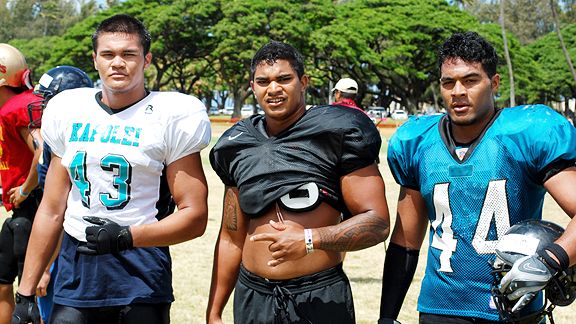
After its first two days, the inaugural All-Poly football camp in Hawaii appears to be living up to its billing of becoming a productive camp on the island each year. With its impressive showing of more than 200 players, the camp has provided a stage for prospective student-athletes to showcase their athletic prowess while learning about college life away from the field.

What makes the All-Poly camp unique is its focus on academics, standardized and entrance tests, core curriculum requirements and other topics needed to prepare and qualify student-athletes for college. On Monday, before any on-field workouts, each participant and some family members took part in a four-hour workshop outlining the aforementioned areas of off-field importance.

The focus of the All-Poly camp is not only football, but also informing these young men about the importance of what is necessary off the field to continue their college careers.

"This is an opportunity to educate kids of Polynesian descent on what it takes to become a prospective college football player not only on the field but off," said UCLA offensive coordinator Norm Chow, a former Hawaii resident who attended high school on the island of Oahu.

Chow was one of 20 Division I and II coaches on hand to instruct, mentor and in many cases give back to their roots. Staff members from Colorado, Oregon State, Utah, UNLV, Boise State, Washington, UCLA, Texas Tech, Louisville and BYU, among others, were in attendance to organize, coach and educate an impressive group of collective talent.

The on-field workouts mirrored classroom education with regard to laying the foundation of the basic principles of the game. Prospects took part in individual drills and group work and eventually were divided into teams that would compete and practice against each other throughout the first two days. Before the workout Monday, athletes were led through dynamic stretching and warm-up routines. The speed training was led by Tom Shaw, a highly regarded strength and conditioning coach with an NFL pedigree.

Shaw was not the only representative on hand with NFL ties. Newly appointed New York Jets defensive coordinator Mike Pettine lectured on the importance of playing the game fast, physically and with a lot of energy. Pettine talked about his coaching days with the Baltimore Ravens and the motors and chase speed encompassed by that defense led by All-Pro defenders like Ray Lewis and Ed Reed.

Pettine made a reference to his prior defense by saying the Ravens' motto was "Play like your hair is on fire." The players at this camp have certainly kept that type of intensity going.

The coaches and instructors were teaching the concept of "thud" (making contact but staying off the ground) the first two days, but with players like these, there's only one speed: 93 octane.

As we scouted the various position groups, the linebacker unit appeared to have the best depth and overall talent thus far. It was led by V.J. Fehoko (Kahuku, Hawaii), a 2010 Under Armour All-America Game selection. After an impressive showing at the All-Poly football camp in Utah last month, Fehoko continued to show why he's considered the top prospect on the island this year. While he's not the biggest or fastest on paper, he simply found the football quickly during nine-on-seven drills, showing reactive athleticism as well as great physicality and strength filling at the point of attack.

Not to be overshadowed on the offensive side, quarterback Andrew Manley (Wahiawa, Hawaii/Leilehua) physically warrants far more recruiting interest than he has received to date. Given his impressive measurables, arm strength, quick release and velocity, it's staggering that this young man only has one offer so far, from WAC member Hawaii. At this stage, Manley is clearly worthy of lower-tier BCS conference offers and multiple non-BCS offers. Manley is not of Polynesian descent but is a Hawaii resident who, based on physical tools alone, is flying under the radar.

Full Article