Showing posts with label polynesians. Show all posts

Thursday, July 2, 2009

Manley, Fehoko Shine Early


After its first two days, the inaugural All-Poly football camp in Hawaii appears to be living up to its billing of becoming a productive camp on the island each year. With its impressive showing of more than 200 players, the camp has provided a stage for prospective student-athletes to showcase their athletic prowess while learning about college life away from the field.

What makes the All-Poly camp unique is its focus on academics, standardized and entrance tests, core curriculum requirements and other topics needed to prepare and qualify student-athletes for college. On Monday, before any on-field workouts, each participant and some family members took part in a four-hour workshop outlining the aforementioned areas of off-field importance.

The focus of the All-Poly camp is not only football, but also informing these young men about the importance of what is necessary off the field to continue their college careers.

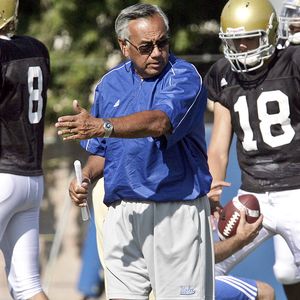
"This is an opportunity to educate kids of Polynesian descent on what it takes to become a prospective college football player not only on the field but off," said UCLA offensive coordinator Norm Chow, a former Hawaii resident who attended high school on the island of Oahu.

Chow was one of 20 Division I and II coaches on hand to instruct, mentor and in many cases give back to their roots. Staff members from Colorado, Oregon State, Utah, UNLV, Boise State, Washington, UCLA, Texas Tech, Louisville and BYU, among others, were in attendance to organize, coach and educate an impressive group of collective talent.

The on-field workouts mirrored classroom education with regard to laying the foundation of the basic principles of the game. Prospects took part in individual drills and group work and eventually were divided into teams that would compete and practice against each other throughout the first two days. Before the workout Monday, athletes were led through dynamic stretching and warm-up routines. The speed training was led by Tom Shaw, a highly regarded strength and conditioning coach with an NFL pedigree.

Shaw was not the only representative on hand with NFL ties. Newly appointed New York Jets defensive coordinator Mike Pettine lectured on the importance of playing the game fast, physically and with a lot of energy. Pettine talked about his coaching days with the Baltimore Ravens and the motors and chase speed encompassed by that defense led by All-Pro defenders like Ray Lewis and Ed Reed.

Pettine made a reference to his prior defense by saying the Ravens' motto was "Play like your hair is on fire." The players at this camp have certainly kept that type of intensity going.

The coaches and instructors were teaching the concept of "thud" (making contact but staying off the ground) the first two days, but with players like these, there's only one speed: 93 octane.

As we scouted the various position groups, the linebacker unit appeared to have the best depth and overall talent thus far. It was led by V.J. Fehoko (Kahuku, Hawaii), a 2010 Under Armour All-America Game selection. After an impressive showing at the All-Poly football camp in Utah last month, Fehoko continued to show why he's considered the top prospect on the island this year. While he's not the biggest or fastest on paper, he simply found the football quickly during nine-on-seven drills, showing reactive athleticism as well as great physicality and strength filling at the point of attack.

Not to be overshadowed on the offensive side, quarterback Andrew Manley (Wahiawa, Hawaii/Leilehua) physically warrants far more recruiting interest than he has received to date. Given his impressive measurables, arm strength, quick release and velocity, it's staggering that this young man only has one offer so far, from WAC member Hawaii. At this stage, Manley is clearly worthy of lower-tier BCS conference offers and multiple non-BCS offers. Manley is not of Polynesian descent but is a Hawaii resident who, based on physical tools alone, is flying under the radar.

Full Article

Tuesday, June 30, 2009

Families to New Zealanders: Just Make Us Proud at JWC

The capital of New Zealand is Wellington. Incorrect information originally appeared in this story.

As Team New Zealand prepared to board an airplane for the start of a 37-hour trek to the IFAF Junior World Championship, parents pulled their sons aside.

They used different words but had the same simple message.

“I was standing near three families all saying the same thing, though in three different languages,” New Zealand head coach Michael Mau’u said Wednesday after his team’s first practice at Walsh University. “They told them, ‘You are going to represent your country and your family. Make us proud.’ ”

So began the long journey for one of the world’s youngest football programs.

Organized football began just 12 years ago in New Zealand, a country whose capital, Wellington, is 8,459 miles from Canton. Football there is so new that Mau’u had to go to Australia to play in his younger days, and played against his home country during the early stages of New Zealand’s international competition.

“The first time Australia played New Zealand, there’s my family in green and gold (Australia’s colors) surrounded by New Zealand’s black jerseys but cheering right along,” Mau’u said. Eventually, he donned New Zealand black as well.

“I tried to explain to the kids what this is all about, what it’s like to play for your country,” he said. “But until they walked in here, I don’t think they really believed me.”

New Zealand and Canada open the eight-nation tournament Saturday at Fawcett Stadium. Quarterback Sloan MacAskill hopes the temperature is cool for the 10 a.m. kickoff. It’s winter in New Zealand, and frost covered the ground the day the team departed.

“It’s hot here. I can tell you that,” MacAskill said when asked about his first impressions of the United States. “It doesn’t feel like half a world away, though.”

MacAskill and his teammates flew first to San Francisco, then waited out a nine-hour layover for a flight to Chicago. A bus ride to Canton gave them a clear view of the American Midwest.

Wednesday was the team’s first chance to stretch their legs on a U.S. practice field. Running back Dan Tavaga impressed onlookers with his speed and maneuverability.

The 5-foot-5, 157-pound slasher took a variety of pitches as the team drilled.

“I like running against the big guys,” Tavaga said. “I sometimes even like getting tackled. It psychs me up.”

Tavaga ran for both touchdowns in his team’s 12-7 win over Australia to clinch a spot at Fawcett. That they come in as the No. 8 seed and heavy underdogs does not faze this group.

Team members had to finance their way here, paying about $2,800 each in American dollars. Because of that, only 37 players made the trip. The ones that did are not taking lightly the sacrifice their families made.

“Our team is very Polynesian influenced, very family influenced,” Mau’u said. “When we played Australia, all the kids had their own rooms but there was a central kitchen area and they all drug their mattresses there to sleep together. Team unity is not something we work at. It’s something they expect and come by naturally.”

Whether that results in wins remains to be seen.

“National honor means everything to us,” Mau’u said. “I told the team to play with no regrets. You can’t leave something in the tank and think what could have been after it’s done. That doesn’t mean we’re just happy to be here. We’ll take our shot at victory if it’s there.”

They’ve come too far not to.

Full Article

Saturday, June 27, 2009

UCLA's Norm Chow Talks Offense

If you just want to cut to the chase, he's the best offensive coordinator in the history of college football.

In 33 seasons at the collegiate level, Norm Chow has been part of three national championships, guided three Heisman Trophy winners, coached eight of the NCAA's top 30 in career passing efficiency and produced six first-round NFL draft picks at quarterback.

But UCLA's offense stunk last year.

It ranked 116th in the nation in rushing, 111th in total offense, 109th in scoring, 109th in passing efficiency and 110th in sacks allowed.

Bad. Very bad.

The good news for Bruins fans, however, is that it seems almost impossible to imagine things not getting better. A lot better, in fact.

It's hard to bet against Chow, 63. His head coach, Rick Neuheisel, also owns a highly respected offensive mind -- though it often appeared that mind was about to explode as TV cameras zeroed in on his reactions to the offensive foibles last fall.

The question is: What are realistic expectations in 2009?

Improving from bad to merely below average might get the Bruins enough juice to win six games, particularly with a defense that should be very good.

But going from bad to average might boost UCLA back into the top half of the Pac-10.

So we thought nothing of calling Chow during his annual Hawaiian get-away to see what he's thinking this off-season.

Taking a quick look backwards: Is there anything you'd change about how you guys ran the offense last year?

Norm Chow: No. I think we were obviously all disappointed. I'm not so sure there was much else we could have done as far as personnel went. We were down to our third quarterback. We started 10 different combinations on the offensive line. Obviously, we were disappointed we didn't do better with just what we were doing. I don't think we could have made dramatic changes. That wasn't our style. We just didn't play well enough and coach well enough.

Considering how successful you've been running offenses, how tough was it for you watching your players struggle to get much of anything going?

NC: It was hard. But it's not about me. It's about our players and their willingness to work, which they did. They played as hard as they could and they did everything we asked them to do. It just didn't work out. It's not their fault. We as coaches have to take the major part of the blame because we didn't get it done. The guys are working hard now and we're looking forward to everything. We've been together for a year now. Prior to us getting there, the quarterbacks told me that we were their fourth different offensive style of ball in four years. What we called 12, [former coach] Karl Dorrell called 92. You go through that four times and it's hard on young guys. Perhaps we should have gone a little slower. We just didn't do what we should have done.

Obviously Rick Neuheisel, a former UCLA quarterback, is an offensive guy. And he's a hands-on head coach. Did you guys ever butt heads during the season?

NC: Not at all. We have respect for each other. We're both trying to get the same things done. We have very similar ideas about offense. No, it was a joy. This past year, of all the years I've ever coached, was the first time I worked with an offensive coach, an offensive-minded head coach. I've always worked with defensive-minded head coaches, both in college and the NFL. They kind of have a tendency to leave you alone. But Rick was very good about suggestions and thoughts. All you're trying to do is get better. We got along very well. In fact, it was fun. He was a joy to work with. He's a nice guy. He's a fun guy. He's an intense guy. He's perfect for the head coaching position at UCLA.

This spring you guys tapped redshirt freshman Kevin Price the starting quarterback fairly quickly: What about him impressed you?

NC: He's bright. He's strong. He's got a nice arm. He understands the game. He hasn't played for two years. He was hurt [his senior year of high school] and was already committed to the University of Washington when we got here, but we talked him into staying down here. He lives 10 minutes from UCLA and always wanted to go there, but I guess the previous staff didn't really recruit him or whatever. So he's a guy who wants to be there. He wants to be a good player. If we made a mistake, we probably should have played him a little bit last year, but the way the season was going and mid-way through the season when we'd have to make that decision about a redshirt and so forth we decided as a staff it would be best to hold him out. So the negative is he hasn't played for two years. The positive is that he understands the offense after being a part of it for a year and he's ready to explode, I hope.

Prince didn't play well in the scrimmages: Why do you think that was and does that concern you?

NC: No, not at all. Scrimmages are scrimmages -- we don't game plan; we just call plays. The defensive guys are trying to get their work done and you're trying to get your work done, so oftentimes it doesn't match, if you will. But I thought he performed well. He managed the offense. Maybe the numbers weren't like they were supposed to be but I thought he did well in the spring.

Fair to say improved offensive line play is really the key to everything in 2009?

NC: That's always the key. An offensive line is always the key. And not that they didn't perform last year -- it was hard on them. We went through a bunch of injuries and we didn't have any continuity on the offensive line. We had to play young guys at various positions because they were the only guys we had, health-wise and everything else. We did what we had to do and I think those guys worked as hard as they could to help us.

Who do you think is going to step up this fall?

NC: Kevin Prince, first. We had a running back who was academically ineligible [in the spring], Christian Ramirez, and we're expecting big things out of him. We had a tight end that broke his foot on the third play of the very first game [vs. Tennessee] who's got a sixth year going, Logan Paulsen. Our receivers are a year older -- Terrence Austin played well; Taylor Embree played well. We're expecting big years out of them. We had a center who transferred from the University of Colorado, started as a true freshman there and we redshirted him last year, Kai Maiava, so we expect him to take over at center. So we have -- how many did I mention -- five or six guys who didn't play last year who we are expecting to [this year]. That and I hope we have some continuity on the offensive line -- we've brought in a couple of new young freshmen and junior college players who we are counting on. Will the team be different? We hope so. They're a year older, a year wiser. The style will be the same; the calls will be the same. So hopefully there will be some continuity there. We just need to get better.

What's the pecking order at running back? How many guys do you like to use?

NC: The order as we go into the fall will be Christian Ramirez, as I just mentioned, and Derrick Coleman, who had a nice freshman year for us. And then we have another young freshman who we held out, Johnathan Franklin, a redshirt who we are expecting big things of. I would guess two of 'em would get a lot of the carries, but I think they each bring something to the table. Johnathan has a nice career in front of him, a nice future. He's a quick, hard-hitting guy. I think if we get a lot of work out of two, and then the third one, if we need him, if injuries take over or whatever.

In your coaching career, can you recall a year when you had really dramatic improvement from one year to the next -- is there a potential parallel to your situation as to how it might go next year?

NC: Well, the first year at USC [2001] we went 6-6 and got blown up in a bowl game -- Utah blew us up [in the Las Vegas Bowl]. Then the next year -- and the years after that -- USC enjoyed great success. We're hoping history will repeat itself like that. People don't realize that Pete Carroll's first year, with [quarterback] Carson Palmer as a junior, we were 6-6.

[In 2001, USC ranked 94th in the nation in total yards (329 per game) and 61st in scoring offense (26.55 points per game). In 2002, it ranked eighth in total yards (449) and ninth in scoring (35.77).]

Do you expect dramatic improvement on offense this fall?

NC: [Laughs] It's a hard call. I think we're going to hopefully be better. Whether that's good enough, we'll just have to wait and see.

Full Article
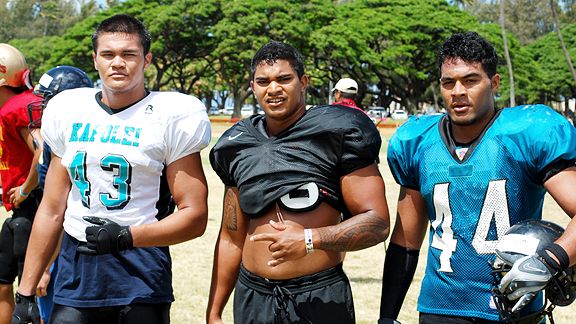
Blocker Manu Mulitalo Set For Brigham Young

A 6-foot-3, 310-pound offensive guard / center prospect, Manu Mulitalo of Granger (West Valley City, Utah) has agreed to sign with BYU's Class of 2010.

He chose the Cougars over offers from Washington State and Navy.


Mulitalo presently plays offensive tackle but lacks the height for the position that we like to see at the major level of competition. A move to guard better suits his physical and athletic abilities. Flashes good explosion and playing strength but must become a more consistent every down player. His lower body flexibility, foot quickness and balance look good; displays explosion and initial quickness coming out of his stance. At times his pad level is too high but shows good playing strength when down blocking or getting to 2nd level defenders; demonstrates he can pull and handle movement in space while playing on his feet. Flashes quick set ability; can slide and play flat footed, will play too tall at times. Possesses strong initial punch but hand placement and extension will need work. As a guard his playing strength and athleticism will serve him well vs. quick power moves. This is a player who must learn to consistently use all the tools available to him; does not play to his full potential, if this happens he could become a more dominant player. Mulitalo will not be an early starter of impact player at the BCS level of competition. A red shirt year will be necessary to develop his full playing potential.

Utes Add Big Body to Class of 2009

Utah has added a Class of 2009 pledge from Joape Pela, a 6-foot-2, 300-pound defensive tackle from Mountain View, Calif. / Foothill CC, Calif., over BYU.

Pela will have four years to play three when he arrives in Salt Lake City this Fall after finishing courses at Foothill.

Tuesday, June 16, 2009

Polynesian Football Players Bringing a Piece of Home, On and Off the Field

Taking an in depth look into the Polynesian way of life on and off the field.

With a look of fierce intensity staring into the sled, Valley College's Polynesian football players stand in the hit-hit position, waiting for the yell from the coach, before swiftly ramming an average of 200 plus pounds of muscle into the machine. By sheer physical force, they exude power and strength, whether it's on the field or clustered together roaming the campus.

Underneath the layers of muscle lie deeply strewn cultural roots. Respect, family, and unity are strong in the Samoan culture. For those who work with them, know them as the hard working, charming men with a smile. Rosemary Smith, administrative assistant for Student Services has worked with several of the Samoans, appreciating their presence in her office and around campus.

"They are extremely loyal, extremely ethical, and being respectful to people in authority is their number one priority," she said. "And always have a smile."

Valley has ten Polynesian football players who mainly dominate the defense. Some come here when they're a young, while others come from American Samoa. Most of them live together under the same roof with Sealecu Cu'upo, the uncle of Defensive Tackle Ino Vitale and Neemia Vitale. Together, they come to valley, take classes, work, practice, and go home.

"It's a cultural thing, we always stick together," said Ino Vitale. "We're used to it … we do everything together."

For the past six years Assistant Football Coach Leon Criner has been recruiting from the American Samoa islands for Valley. He uses telephone, fax, and email to offer the gifts of pigskin, education, and the mainland. He's attracted to their home grown Polynesian size.

"They're unique," he said. "They have big skeletal structures, and they're quick, which are two qualities that we look for in football."

Criner has been recruiting for the past 15 years, and in his time he's seen three of his finds make it to the pros such, as Issac Sopoaga, defensive tackle for the San Fransisco 49ers, Lofa Tatupu linebacker for the Seattle Seahawks, and Jonathon Fanene defensive end for the Cincinnati Bengals. It's players like Sopoaga that motivate Monarch defensive tackle Jacob Laumoli on the field.

"He inspires me a lot, I want to be like him," he said. "He has the same Samoa attitude, he's rough he's tough, that's why I like him. He's the baddest person on the field; he screams a lot, he plays with intensity."

Some like Laumoli, along with Neemia Vitale, Wayne Samalaou, Reggie Nifo, and Kasimili Vitalia made the trip over from American Samoa last summer to play football. Their home is a cluster of six Polynesian islands located fourteen degrees below the equator in the South Pacific, not far from New Zealand. They play the game out of love and a desire to make something for themselves.

"Football is a way out from the island. I'm trying to do something good with my life," said Wayne Samalaou, safety and linebacker for the Monarchs. "I'm trying to make my family proud, I'm trying to represent my people."

The trip over came with the traditional difficulties of becoming accustomed to a new land. In comparison to the island life, even minute things can be drastic for anyone new to town. Inside linebacker, Reggie Nifo, recalls his experience when he flew over last summer.

"The first thing came up to mind when we got here was the weather, when we got here it was June 29 [2008], it was pretty hot especially in the Valley," said Nifo. "Second thing is trying to fit in to seeing different races of people. Back at home you only see our kind, not much of those different races."

Coming from a total population that maxes out at 65,000 according to CIA: The World Factbook, back home would mean chores and helping out with their families. Plantations are common, where after school they would work on the farm producing fruits like taro and bananas.

"In L.A. it is way different, out here people are pretty much stressed out about paying rent money and buying food and stuff like that, but back at the island you don't even worry about that," said Nifo.

Another Samoan staple is the tradition of music and dance. Anyone who attended their fall games saw the team engaged in a dance, known as the war dance, before the game.

"If you saw any of our games last year we allowed them to do a pre-game war dance," said Criner. "It's was just kind of a spiritual thing, just to get the kids motivated a little bit, and it was a fun thing. The crowd was having fun watching it."

Full Article