Showing posts with label college football 2012. Show all posts

Sunday, September 2, 2012

The Marcus Mariota Era Enters With a Bang

The University of Oregon ripped off 50 points in the first half of its season opener against Arkansas State. But I can't, and won't, join those who believe they learned absolutely nothing about the Ducks in Saturday's installment of the Cupcake Challenge Series. 

Turns out, the first Ducks freshman to start at quarterback in 22 season openers, Marcus Mariota, has a mother who would like her son's last name correctly pronounced. Can't say I blame her. Sports information director David Williford confirmed Mrs. Mariota called the university to inform them it's pronounced "Mar-ee-oh-TAH" not "Mar-ee-ohtah." 

It's going to take repetition to get that right, but we all learned something on Saturday. 

It was Oregon 57, Arkansas State 34 in the season opener. That's pronounced: "LAFF-er." 

Here's what the first-half 50-point mark looked like in the second quarter: Ducks running back Byron Marshall scores a touchdown on fourth and goal from the 3 (assisted by Mar-ee-oh-TAH, who helped pile-drive his teammate across the goal line). Kicker Rob Beard makes the extra point. Williford leaps out of his chair, and jogs across the press box to one of his intern staffers, who was told to immediately research school scoring records. 

The intern was stoked. 

But the kid was nowhere near as focused, and excited, and crisp as the inexperienced, unproven Mar-ee-oh-TAH was in his debut. You can call Arkansas State awful (and the Red Wolves were). You can point out that the Ducks should have been playing Kansas State or New Mexico (and we all would have preferred it). You can say that we're not going to know how good Oregon is for more than a month (also very true). But what's not in doubt is how good Mar-ee-oh-TAH is. 

He was accurate. He was poised. He was agile. Mar-ee-oh-TAH mostly made good decisions. He demonstrated leadership, and appeared to be in command of the offense. What I'm trying to say is that he looks talented enough to show up on campus and chase a starting quarterback with two conference championships into the woods. 

If he hasn't already, Mar-ee-oh-TAH is going to make you forget Darron Thomas. He completed 12 of his first 13 and finished 18 of 22 for 200 yards. He threw three touchdown passes. He had a nice 17-yard run himself and helped push that teammate over the goal line in a critical situation. Save for one messy incompletion, and a misread of the defensive end on an option (he should have kept the ball and instead gave it to Kenjon Barner), this kid was pristine in his debut. 

I am not mocking Mrs. Mar-ee-oh-TAH by giving the phonetic pronunciation of her son's last name. I'm making sure I drill the correct pronunciation for you and for me, especially. Because I learned in two otherwise meaningless quarters of blowout football on Saturday, one play at a time, that we'd all better get this kid's name correct. He's going to be here a long while, and he's going to be memorable. 

Mar-ee-oh-TAH even sounds good. That "TAH" at the end punctuates it. Feels like it could easily turn into "Mar-ee-oh-TAH-DAH" with very little imagination. 

When it comes to Ducks quarterbacks I always like to go to Joey Harrington for an appraisal. The former NFL quarterback and Ducks star studies the game, and mechanics, and sees things on another level. And so at halftime, I reached out to Harrington, who is in Los Angeles preparing for his Fox broadcast gig. 

Columnist: "What did you think of Mar-ee-oh-TAH?" 

Harrington: "Barely got to see it. On set in LA. By the time I got to the TV it was 42-3!" 

Well put, Joey. Circle back after we see more. But I suppose what Mar-ee-oh-TAH did against Arkansas State was exactly what he did in fall practice, where he asserted himself as the winner of a tight quarterback competition. There will be tougher challenges, there will be bigger moments, but I saw enough to know how dangerous Mar-ee-oh-TAH can be in this offense. 

That first half featured seven Oregon trips to the red zone and six Ducks touchdowns. Mar-ee-oh-TAH pulled his helmet off with 7:06 left in the second quarter. His team had 50 points on the board. And for the first time in his playing career at Oregon I saw something that I believe we'll see a lot of over the next 24 to 48 months. 

Mar-ee-oh-TAH smiled. 

That's pronounced SMILED. 

Full Article

Wednesday, August 29, 2012

American Samoa Players A Long Way From Home

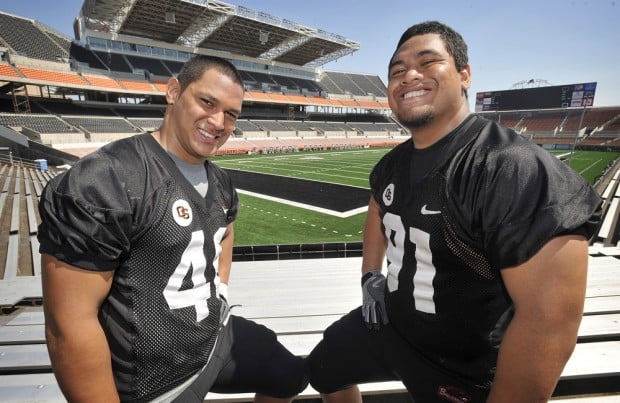
Oregon State freshmen Rommel Mageo, left, and Noke Tago are attending school 5,000 miles from their home in Pago Pago, American Samoa. (Andy Cripe | Corvallis Gazette-Times)

Noke Tago’s first airplane ride was a long one.
A flight between American Samoa and the United States is roughly 15 hours.
If you’re lucky.
Tago said he flew eight hours to Hawaii, waited there for another eight hours and then made the five-hour trip to Oregon.
Tago and Oregon State teammate Rommel Mageo, also from Pago Pago, American Samoa, are both in Corvallis practicing with the Beavers’ football team.
It’s their first time away from home. And home is 5,000 miles away.
“Living a different life, it’s good for me because this is my first time I leave my parents and I stay away from my family,” Tago said. “So the first week I was homesick a lot and I missed my family.”
Mageo’s brother, Natanu, played for North Carolina State two years ago and had the benefit of talking to him before making the move.
“My brother played at N.C. State, so it was a big thing for me,” Mageo said. “He helped me out with a lot of things and he told me all about camp and everything.”
Moving halfway across the world is a big decision.
For Tago and Mageo, it’s a change that they were willing to make.
Few in American Samoa get a chance at college. Or more.
Career prospects are slim at home.
Football is their opportunity.
The American Samoa game
Football was introduced to American Samoa, an unincorporated territory of the U.S., in the 1960s.
While rugby is huge throughout Polynesia, including neighboring Independent State of Samoa, football stuck in American Samoa with the help of television.
The physical nature of the game turned out to be a natural attraction.
“In American Samoa, American football is big,” OSU defensive line coach Joe Seumalo said. “That’s their only form of entertainment.
“They’re raw at the game but they understand the physicalness of it and they love it. They’re no different than a lot of kids over here in the U.S.”
Until Pop Warner started up recently, most of the organized football was played at the high school level.
That means that most players from American Samoa who were good enough to come to the U.S. and play have been raw.
Mageo, a linebacker for OSU, has been playing the sport for five years.
He started in eighth grade.
“It wasn’t really around because we didn’t have youth football. It was only high school, so when you’re little, all you look up to is high school football,” Mageo said. “So when I was in eighth grade I really wanted to play football so I tried out.”
Tago played rugby when he was younger.
A defensive tackle for the Beavers, he’s now 6-foot-1, 290-pounds.
When he arrived in high school the football coaches took one look at him and convinced him to play.
“My freshman year I didn’t practice the whole summer,” he said. “I just come to school and register and the coaches wanted me because they saw me and I’m big. They wanted me to play for them.
“I had more confidence in myself because I played rugby.”
Seumalo said the rules governing football in American Samoa are limited, so the players are able to practice and play year-round.
The players are different as well.
Size is not lacking among the young men of American Samoa.
It’s easy to find linemen and linebackers.
“Football there is different from here,” Mageo said. “There it’s mostly about strength. It’s not really about speed, but everybody’s strong out there.”
The players condition constantly but weight training isn’t common.
Tago said he did a lot of work cutting trees and grass and did push-ups every night before bed.
“We have to do our chores. Every day we do our plantation, grow taro,” Tago said. “That’s where we get our muscle built.”
The recruiting game
Attracted by the size and potential, college coaches have looked for Samoan players for some time now.
Many players of Samoan descent, such as Troy Polamalu, Marques Tuiasosopo and the late Junior Seau, have made the climb to the NFL.
The University of Hawaii has been stocking its roster with Samoan players for years.
Access to the athletes who were already living in Hawaii or on the mainland was simple. Getting to those in American Samoa is a different story.
Film has often been used to evaluate the players.
Recruiting trips to American Samoa have always been tough for college coaches.
“Everyone knows about American Samoa, it’s just that you have flights that are limited, so if you go there, expect to stay there for a couple days because the next flight is three or four days later,” Seumalo said. “And in Samoa, you could probably do it one day, you could do all your reruiting in one day there. But with NCAA rules, these are the dates you can go out and if you go there, you kind of lose a couple days by being out there.
“We just have to be smart in how we do it.”
While there is a good group of American Samoan players who made the trip to the U.S. to play football this fall as freshmen, most of them went to junior colleges.
Four received full-ride scholarships from Division I teams.
Tago and Mageo were two. The other two are Robert Barber and Destiny Vaeao of Washington State.
“Coming here, it’s a big deal, so it was a big thing on the island,” Mageo said. “It was all over the newspaper and everywhere.”
OSU can provide the education and the base for a future career.
“It’s a way for us to get in and get some of those kids and develop those kids,” Seumalo said. “Because you can count the amount the kids that have grown up in the islands, whether it be Samoa or Tonga, that have made it here and played the game of football.”