Saturday, October 15, 2011

Stamp of Approval To Go On American Haka


It's the haka, but not as we know it.

As the All Blacks international fame grows, an American college football team has taken to performing a whooping, crowing, hybridised version of the team's haka Ka Mate before games.

Ka Mate guardians Ngati Toa said they have no problem with the team using the haka – but they could do with a bit of discipline and technique.

The San Mateo Bulldogs American Football team has posted footage of its pre-match haka on its Facebook page and it is clearly based on Ka Mate.

The players stand in a circle whooping and jumping during the routine which then breaks into part of another haka, possibly Ngati Kahungunu's Tika Tonu, at the end.

"You can't fault their enthusiasm," said Teariki Wi Neera, who is on Ngati Toa's Ka Mate sub-committee.
But he said their rendition was a bit like "a bad Coke ad".

"We're incredibly proud of Ka Mate and we prefer to see it done properly."

Wi Neera said Ngati Toa would be happy to provide some instruction, an offer Bulldogs assistant coach Tim Tulloch said his players would be "ecstatic" to receive.

Tulloch said the players started performing haka before their games in 2009 and that year the team won the Northern California championships.

"I think it catapulted us to that championship. There's not a game since we have been doing this that we have not been ready for battle."

The team performs the haka in the dressing room as performing it on the field is a "decorum violation". Two decorum violations see a team suspended from the competition.

Tulloch said San Mateo, just south of San Francisco, had a large Polynesian population and one of the players on the team, Samoan Lyman Faoliu, had selected the haka they wanted to perform.

Faoliu had taught the team about the haka's history and significance but some input from a real Maori tribe would be "amazing", Tulloch said. 

Thursday, October 13, 2011

New York Jets Add Martin Tevaseu to Active Roster

The Jets have signed defensive tackle Martin Tevaseu to the active roster.

The UNLV product was activated for the AFC Championship Game last season and played well in the snaps he got. He also started over Kenrick Ellis in preseason when Sione Pouha was hurt. This move probably makes it less likely you will see Ellis on Monday.

The move is timely since the Jets are facing a backup quarterback getting his first start of the year Monday.

I like Tevaseu. He has played pretty well in that Playoff game last year and then in stretches of preseason ball. This coaching staff seems to do very well drilling consistent technique into defensive linemen. The undrafted player could potentially work himself into the equation as part of the rotation if he plays well.

This might also send a message to the defensive line as the Jets have given up big rushing days two of the last three times out. It could also have to do with a knee injury Ropati Pitoitua is allegedly nursing.

Tuesday, October 11, 2011

Pride Pushes Te'o To Greatness

He's more than just a big man on campus.

Manti Te'o is Notre Dame's Big Kahuna.

The junior Irish linebacker is the most popular export from paradise since pineapples and the Elvis Presley Classic, "Blue Hawaii."

Here on the mainland, or any other land, the 6-foot-2, 255-pound Te'o is special.

He's a tackling machine, fueled by skill and precision. Every stop is a clinic, heavy on fundamentals.

Te'o is so good, Notre Dame football fans might be tempted to take him for granted. Opposing offenses certainly won't.

If he's not making 21 tackles, like he did last season against Stanford, Te'o's efforts risk being considered pedestrian.

In last week's win over Purdue, Te'o had eight tackles. Hardly eye-popping. But with three tackles for loss, including a sack, his performance caught the attention of head coach Brian Kelly.

"He might have had his best game against Purdue," Kelly said. "He was very detailed. He's never a guy we worry about in terms of how he's going to play. Sometimes he tries to do too much. I thought that was his most disciplined game.

"He can recognize things before they happen. That's film study. The really great players have that."

Te'o had somewhat of a challenge going into the Purdue game. Coaches didn't hesitate to remind him that last year's season-opener against Purdue may have been his worst game.

"We talked about (how bad he played against Purdue last year)," said Irish defensive coordinator and linebackers coach Bob Diaco. "He had a lot of opportunity for production that didn't happen."

"I obviously understand what kind of game I had last year," Te'o said. "It wasn't the kind of game I want to have. I was just looking to get better, make sure it didn't happen again."

While cutting his teeth as a big-time contributor within the Notre Dame defense last year, Te'o dealt with growing pains. Consistency suffered. One time he'd lay the wood. The next, he'd whiff.

"We identified liabilities in every single player," Diaco said. "The players that are really at the top of their game, it's easy to just overlook them and focus on ...

"(Te'o) had things in his scheme that he needed to clean up. In the offseason, I made a cut-up of plays of just him and gave him an opportunity to watch it. It made a pretty big impact on him. From that moment, he's made a concerted effort, not only to do the things that we're working on, but he takes a lot of time and focuses on his liabilities - angles, foot action, transition from speed to power. He's basically eradicated that from his game."

"That cut-up (Diaco) made, showed me the mistakes I made," Te'o said. "It started from my angles. I got to see what happened. When you look at it like that, you can visualize, analyze and correct it. My dad (Brian) helped me a lot, reminding me of basic tackling fundamentals.

"I'm still trying to find a balance (in tackling). I'm trying to knock somebody out every time I hit them. I'm learning, when I'm in space and it's open-field tackling, it's not necessarily smart to try to take somebody's head off.

"If there's an opportunity to take somebody out, I'll take advantage of that. If it's open-field and I need to get the guy down, I'll get the guy down."

Monday, September 12, 2011

Time To Re-Sign Haloti Ngata


One of the biggest stories of the Ravens offseason were the contract negotiations of Haloti Ngata.  The Ravens defensive tackle holds the team’s franchise tag this season and was frequently referred to by local and national media as a reason that Baltimore was unable to make a large free agent splash.  After week one, fans aren’t so worried about that anymore.
Ngata proved his worth once again with a dominant performance against the Ravens rival the Pittsburgh Steelers.  In Baltimore’s 35-7 win, Ngata came up with two fumbles and tipped a pass that resulted in an interception.  (It’s crazy to think that those turnovers were less than half of the defense’s total on the day!)
Ngata is a force on the Ravens defense.  Not only can he cause chaos to quarterbacks and running backs, but he also has the speed to catch guys in the middle of the field.  His size to speed ratio makes no sense, but it’s perfect for the Ravens d.
After the game, Ngata told Aaron Wilson that his contract status remains the same.  He said that he lets his agents handle the deal, “hopefully it will get done,” he said.

Thursday, September 1, 2011

So'oto, Lattimore Battle Way Onto Field


The position was new. The attitude, not so much.
Arms crossed, Vic So'oto stands at his locker. This 6-foot-3, 263-pound brick house of a man admits his temper is short. His patience runs low.
A tight end-turned-defensive end at Brigham Young, So'oto was converted to outside linebacker in the Green Bay Packers' 3-4 scheme. Management figured position coach Kevin Greene could never have too many fire-breathing pupils.
Yes, it's been a perfect fit.
"As a Polynesian, Samoan type of guy, cracking skulls comes naturally," So'oto said. "It's something you're born with."
One more game of "cracking skulls" is probably all So'oto needs to lock up a roster spot. Heading into Thursday's preseason finale against the Kansas City Chiefs at Lambeau Field, So'oto and fellow undrafted rookie Jamari Lattimore of Middle Tennessee State are positioned well. Both outside linebackers have grown up as quick as anyone on the team.
Good timing, too. Erik Walden ran away with the starting spot opposite Clay Matthews, but the backup slots at outside linebacker remain jumbled.
After suffering a broken shoulder blade, Frank Zombo's immediate future is uncertain. Brad Jones, expected to compete for a starting spot, hasn't stood out. And sixth-rounder Ricky Elmore never adapted.
Which leaves So'oto and Lattimore. They're cast in two completely different body types. So'oto is built like a security guard, Lattimore like he could double at safety. In a hurry, both matured from half-clueless rookies to contributors on the verge of cracking an NFL roster.
"I feel like everything is coming to a head," So'oto said. "This is the last game to prove myself. Hopefully I can do something that the coaches like and they'll want to keep me around."
Transitioning from a 4-3 end to a 3-4 outside linebacker runs deeper than X's and O's. Greene, a 15-year NFL veteran at the position, explains.
"It's always a vision thing," Greene said. "You go from having your hand in the dirt and looking straight ahead to standing up and actually having to acquire all of the eligibles and where they line up and what does that mean to you and your pass coverage."
So'oto relies on the darkness inside of him, his mean streak. Part of him wants to be a UFC fighter. He loves watching George St. Pierre and Rampage Jackson. His given name, Vitale Ta'aga Magauli So'oto, even has a cagefighting ring to it. So'oto knows his wife - the driving force behind him picking Green Bay over Arizona and Miami after the lockout - would not approve.
So football it is.
One ESPN article estimated that a Samoan boy is 40% more likely to reach the NFL than any other boy in America. So'oto has one theory. It's in his makeup to embrace contact, to be the aggressor.
The "warrior mentality" of the culture, So'oto says, dates back to when fossils from all over the world were found in Samoa.
"When you travel somewhere, and don't know someone else, you automatically fight," he said. "So it's fun to be from something like that . . . It's no-nonsense, short temper. You're happy-go-lucky until it's time to strap it up. That's just how I've always been."
Last weekend was So'oto's breakout performance. He has been assignment-sure in practice, rarely enveloped at the point of attack. Against the Colts, he beat starting right tackle Ryan Diem and forced a fumble that Green Bay recovered. Then, on a second-and-1 play in the fourth quarter, So'oto showed good instincts in immediately penetrating into the backfield to lasso running back Darren Evans.
"I'm a really laid-back guy until game time," So'oto said. "If I were to fight, it'd be totally different. It's football, just football."
Greene, by nature, is a fan.
"I hope I inspire all my kids to mix that (crap) up," Greene said. "We need to get up into peoples' grilles. Absolutely. Vic is passionate about the game. That's what I preach all the time. You have to love hitting people."
With Lattimore, textbook technique is imperative. The 2010 Sun Belt defensive player of the year relied on pure athleticism in college to total 68 tackles, 15 tackles for loss, 11½ sacks and 10 quarterback hurries. In the pros, at 230 pounds, he's ultra light for the position.
As of now, Lattimore often takes on blockers 75 to 100 pounds heavier. Greene stresses, however, that Lattimore can overcome this discrepancy with the proper footwork and hand placement.
In his playing days, Greene's playing weight hovered in the 242-to-245-pound range. At one point, in a 4-3 scheme, he even dipped to 238 pounds. The plan with Lattimore is obviously to pack on weight. Today, 3-4 outside linebackers must play between 245 and 252 pounds, Greene said. The game has evolved.
It's difficult to pack on pounds during the 90-degree dog days of training camp. Soon, Lattimore will start a weight-gaining diet of some sort.
In the meantime, technique has helped him survive and thrive.
"Something I learned as a player was that no matter how big an opponent was, as long as I had good technique, I could defeat that opponent," Greene said. "Now (Lattimore) is playing a position that requires him to be a little heavier. He's light at 230, but with the right technique he can beat someone that's 330."
Added Lattimore, "With the right technique, you can do it all. Technique and fundamentals. Every day, nonstop."
And, Lattimore does have some experience at the position. As a kid, he always played as the Carolina Panthers on the video game, Madden. He'd toggle his controller to Kevin Greene and blitz off the edge. Little did Lattimore know that exact job would be his ticket to the NFL.
And Greene would be his coach.
"He knows what he's talking about and been in that position," Lattimore said. "I haven't told him I played as him. I don't want him to get big-headed."
Expect to see plenty of both rookies Thursday night. They've come a long ways. That first week of practice, Dom Capers' scheme was a maze of confusion. Offensive players motioned and Lattimore admits, on some plays, he had no idea what to do. Now Lattimore and So'oto are confident.
The preseason finale, they hope, serves as an exclamation point.
"Nothing's guaranteed," So'oto said. "I know that and everybody's been telling me that."

Wednesday, August 31, 2011

Meet The Most Interesting Man In College Football


Allow me to go back in time to last June.  I sat in Columbus Crew Stadium watching the inagural USA College Sevens rugby tournament.  The best rugby teams from around the country came together for this wide-open, entertaining competition that highlighted rugby sevens as a future Olympic sport.  As I watched several games throughout the tournament, one man caught my eye from Utah.  A mountain of a man of Samoan descent with long black hair in the red #2 jersey.  He was simply bigger than everyone else on the field, and to my shock, faster too.  And if that wasn't enough, he had the NCAA '10 highlight stick at his disposal like it was the simple flick of a thumb.  Game after game, #2 from Utah ran in try after try as the Utes advanced through the tournament.  He ran around tacklers, through tacklers, and past tacklers.  As the tournament progressed, this mythical creature became the talk of Crew Stadium.

But #2 and his Utes met the toughest test imaginable in the final - the Cal Bears.  All you need to know about college rugby is this... Cal.  Wins.  Everything.  They have only 25 National Championships to their name and the consensus favored the Bears adding the presitgious sevens tourney to the trophy case.  Except, this Herculean force of nature from Utah had other ideas.  Utah stunned the Bears in a thrilling game 31-26 in overtime, largely thanks to two tries from #2, the hero of the tournament.  

Utah's #2 was a 21 year old freshman, Thretton Palamo... the youngest player to ever take the field in the Rugby World Cup when he did so in 2007 for the USA national team in France.  A former captain of the USA rugby sevens team.  And as of this Fall, a running back for Kyle Whittingham's Utah football team.  And quite possibly, the most interesting man in college football...
For the readers that may be familiar with rugby, watching Palamo anihilate the college sevens tournament last year must have been what it was like to watch Jonah Lomu at his peak.  Even though there were dozens of games each day, I wanted to be in Crew Stadium when Utah was playing to watch Thretton Palamo.  The level of competition was inconsequential at that point and time - what I saw that weekend (and what viewers saw nationally on NBC) was transcendent.  Palamo is a world class rugby sevens player with athleticism to match.  Here's a 6'2", 240 pound rock of granite that also had the ability to sidestep any defender, the pace to outrun the others, and the power to brush off anyone else that may have gotten in his way.  Any time he touched the ball, the crowd on hand would slowly out of their seats like they would for Gale Sayers or Reggie Bush.  Any time he touched the ball, you knew he was likely to score.  It didn't just look like a man against boys, it was like watching Gravedigger do his (her?) thing.  Just see for yourself...
And now Palamo takes those talents from the pitch to the gridiron.  The trip from teenage international rugby player to Utah running back is in the words of Bill Walton, a long strange trip.  Palamo was teammates on that '07 RWC team with Utah rugby head coach Blake Burdette, who also happened to be a member of the Utes' 2004 unbeaten Fiesta Bowl team.  Utah was the perfect fit for Palamo's rugby skills, desire to play football, and committment to get an education.  In fact, Palamo chose this path at Utah turning down opportunites to play professional rugby in Europe.  To tell you the truth, I was stunned and excited when I read his name in the rotation at running back for the Utes this year because I saw his athletic genius with my own eyes.  Sure, Youtube highlight videos are all the rage for college prospects, but nobody has quite the resume of Thretton Palamo to back it up.

Just how much of a factor can he be for the Utes though?  It appears Palamo will start the season as a backup to JuCo transfer John Whitepalamorb even though he led the Utes in rushing during their first Spring scrimmage.  Palamo did play football in high school, but the learning curve is still steep.  To his credit, Whittingham and the staff see a bright future for the rugby star, but his impact may not be felt immediately.  Actually, Palamo may never make a significant impact in football, period.  Transitions between sports are always difficult, no matter the athletic gifts one may possess.  Reading blocks, running routes, and completing blocking assignments is way different than offloading in the tackle, rucking, and running through the gaps of a rugby defense.  The level of athlete from college rugby to Pac 12 football is also a huge step up in class.  No longer will Thretton Palamo be the most gifted athlete on the field by light years.  To his credit though, the coaching staff and players see Palamo's potential...

“Thretton’s doing a good job,” (running backs coach Dave) Schramm said. “It just takes time. He’s got to learn how to play. And he is learning. He’s come a long way — light years since spring ball. But football isn’t rugby.”
“He’s one of those guys who has the inner desire to be great. He’ll get better with time, I think, and end up being a heck of a football player.”
“He’s still raw,” (QB Jordan) Wynn said. “But he’s so big and he’s super-athletic. He can run inside, obviously, but he’ll turn the corner on you, too.”

Everything coming out of Utah this preseason has Palamo dedicating himself to make the transition from international rugby star to college running back a success.  If Palamo is able to grasp the position and fulfill his athletic potential, the possibilities are limitless.  My only hope is that he gets a chance to prove what he can do as a runner on Saturdays because we've never had the chance to see an international caliber rugby player take on college football.  If there is any way to translate the magic on the field at Columbus Crew Stadium last June to Rice-Eccles Stadium this Fall, Thretton Palamo may become a household name.  And even if that doesn't happen, he's still the most interesting man in college football.

Tuesday, August 30, 2011

Homecoming King


Steelers safety Troy Polamalu spends a week renewing his fighting spirit in American Samoa this summer


COULD YOU BE LOVED
The alofa (love) for Troy Polamalu is evident as soon as he arrives at Pago Pago International Airport. Polamalu, 30, was born to Samoan parents in Garden Grove, Calif., and grew up in Tenmile, Ore. He says the entirety of his only other trip to Samoa, taken a decade ago when he was a relatively unknown USC safety, was less eventful than the initial moments of this visit. "It reminds me of that documentary When We Were Kings," he says. "Everywhere Ali jogged, there were a hundred people jogging behind him. That's what I felt."

photo act 4Chris Baldwin for ESPN The MagazineHigh school football players attend a three-day camp with Polamalu.
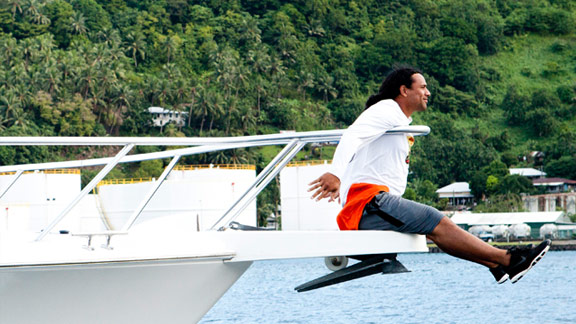
HONOR CALL
Polamalu, with wife Theodora (bottom), is seated and honored as a visiting matai (chief) at his first 'ava ceremony, a welcoming gathering. Because he didn't grow up here, Polamalu leans on former Steelers teammate Shaun Nua (behind Polamalu in yellow) for guidance throughout the trip. Nua, a BYU graduate assistant, is from the same village (Ta'u) as Polamalu's family. Says Theodora, "Troy is trying to learn all the true Samoan ways."

photo act 3Chris Baldwin for ESPN The MagazineAfter hours of practice, Polamalu's trainees still have energy to spare.
HEIRS APPARENT
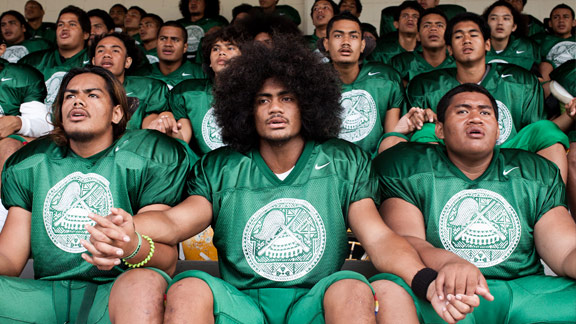
Wearing equipment donated last year by Polamalu, 660 football players from seven high schools show up at Veterans Memorial Stadium in Pago Pago for his three-day camp. "Our football here is very raw," Polamalu says. "It's big hits and very physical."

photo act 5Chris Baldwin for ESPN The MagazinePolamalu says he feels most connected to the islands during two fishing trips.
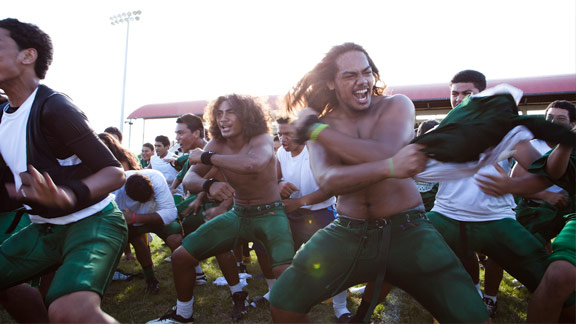
TRUE PASSION
After seven hours of drills in the code-red heat, the players perform Samoan Haka war dances before a mesmerized Polamalu.

photo act 6Chris Baldwin for ESPN The MagazineHis two kids help keep Polamalu grounded during the whirlwind trip.
DEEP DIVE
During the week, Polamalu husks coconuts, weaves baskets with palm leaves, swigs kava (a root drink) and eats a freshly killed pig that's been roasted in an umu (earth oven) -- all Samoan traditions. But he feels most connected to the island on two fishing trips and swimming around with pals. "The ocean has so much energy," Polamalu says.

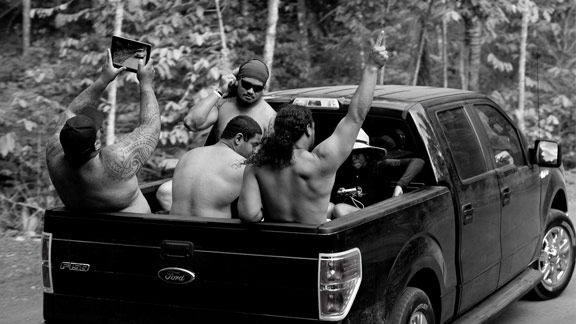
photo act 6Chris Baldwin for ESPN The MagazinePolamalu takes a final "Samoan limo" ride before departing.
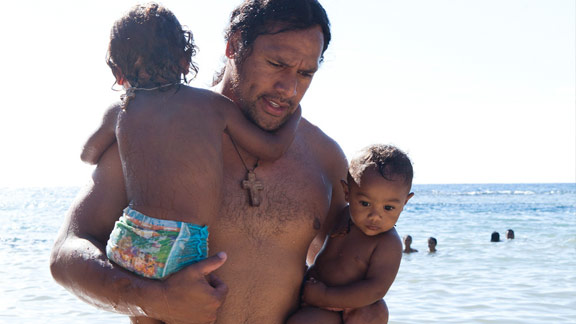
EGO TRIP
Polamalu admits that all the attention during the trip freaks him out a bit. "A few women even tried to make out with me," he says, laughing. "If you fight it, it will be like a confrontation, so you kind of give in -- to a point." To keep himself centered, he spends time with sons Paisios (left), 2, and Ephraim, 11 months. "You have to tell yourself, I'm no better than anyone else," he says. "That's a real spiritual battle. If I would have done this trip even two years ago, I wouldn't have been ready for it."

NO MAN IS AN ISLAND
After a beach feast, Polamalu and crew take a final "Samoan limo" ride before returning to the airport. "Every day I've had to fight back tears," Polamalu says. "I feel joy." It's a feeling that he's eager to bring to the Steelers' locker room. "I've never felt comfortable helping guys on my team," he says. "I was really introverted, and that was all ego, because everything was about me doing what I needed to do to be successful. But I'm becoming a little bit more extroverted now, because I'm starting to take a step back. Now it's time for me to share."


Former QB Pritchard Absorbing, Spreading Knowledge as Stanford Assistant Coach


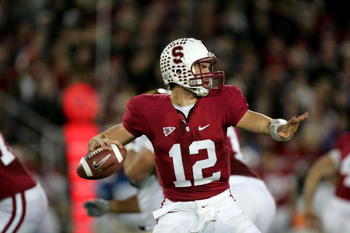
Former Stanford quarterback Tavita Pritchard (2006-09) has lots of stories he can tell the younger players on Stanford's football team.
Pick a story, any story.
How about the one where the Cardinal went 1-11 in 2006, achieving the worst record in school history?
That's more of a nightmare, but Pritchard would prefer to talk fairytales.
How about the time he engineered "The Greatest Upset Ever" on Oct. 6, 2007?


The Cardinal trekked to USC as a 41-point underdog, then proceeded to pull off a miraculous 24-23 victory. Pritchard was making his first collegiate start in place of starter T.C. Ostrander, who had suffered a seizure at a restaurant earlier in the week. Pritchard connected with Richard Sherman on a must-have fourth-and-20 play on a final desperation drive. With less than a minute to play, Pritchard hit Mark Bradford for a touchdown to tie the score. Derek Belch's extra point was the game-winner. Pritchard, who threw for 2,865 yards and 15 touchdowns at Stanford, is now a defensive staff assistant after serving as a volunteer coach last season.
"Still being around the Stanford community, a lot of people bring that USC game up," Pritchard said. "It's a good memory. It's one of the signature wins that people look back to. It's fun to think back on the players and the teams we forged. We think of that rebuilding stage, in general."
***
Pritchard seemed destined to be a coach. His father, David, was an offensive coordinator at Clover High in Washington, where Pritchard starred under dad's tutelage. Tavita Pritchard was a 7-year-old ball boy when David was offensive coordinator at nearby Centralia High. Tavita chose quarterback because his uncle, Jack Thompson -- known as "The Throwin' Samoan" -- was an All-American quarterback at Washington State.
"I learned tons of football from my dad," Tavita said. "My passion for football comes from my dad. I can remember the days when I was a little guy running around with my jersey hanging down to my knees when I was a ball boy. That's where I gained my passion and it blossomed from there."
While coaching is, obviously, in Pritchard's blood, he's coaching for other reasons.
"It's everything I loved about being a player," Pritchard said. "It's the camaraderie, it's the unity, the one mind trying to accomplish a single goal. I love the strategy behind it. I'm like a little kid up in the office just listening to the coaches talk. I love hearing about football and how all the philosophies come together."

Bengals Linebacker Rey Maualuga Adjusting To Transition


Rey Maualuga leads the team with eight solo tackles and that's adding into the idea that the team's starting middle linebacker hasn't even played more than a handful of snaps during maybe five quarters of three preseason games. Would it be that big of a stretch to call Maualuga the Cincinnati Bengals top defensive player?
Maualuga played two seasons as the team's starting strong-side linebacker since joining the Bengals during the second round of the 2009 NFL Draft. This year with Dhani Jones not returning, Maualuga is finally making the transition into his more natural middle linebacker spot. Even so, he's still adjusting, thinking too much about the play before letting his natural instincts take over.
"It comes and goes," he said. "I think in due time everything will unveil itself and I'm just going to go out there and play ball instead of thinking too much."
Star-divide
Bengals defensive coordinator Mike Zimmer agrees:
"He's adjusting to making the calls," Zimmer said. "I think he's been playing the run good and actually has been OK on the pass."
Maualuga's transition comes at a good time, considering that the Bengals are largely a team rebuilding with a new offensive philosophy with new skill players. By this time next year, with the offense having a year under their belts, so will Maualuga as the defensive leader and middle linebacker.