The Latest News and Information Regarding Polynesian Athletes in Various Football Divisions.
Tuesday, March 13, 2012
Falcons Add Lofa Tatupu
Monday, September 13, 2010
Lofa Tatupu Comes Full Circle
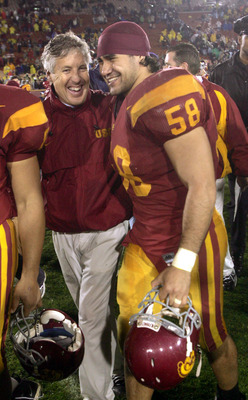
He had waited years for this moment, without any certainty it would arrive. Now he stood in the same place his father, Mosi, once stood, anticipating the arrival of Trojans coach Pete Carroll.
A door opened and Carroll practically bounded toward Tatupu, hand outstretched.
“He came in and shook my hand and said, ‘Congratulations, you’re a Trojan,’ ” Tatupu said after a recent Seahawks practice. “It’s still one of the best days of my life. It was a feeling of disbelief. I didn’t expect a scholarship. I just wanted the opportunity to play.”
Coming out of King Philip High in Wrentham, Lofa Tatupu wanted more.
He wanted what his father had. He wanted Saturday afternoons in the fall with 80,000 people cheering him. He wanted a chance to play for national championships. He wanted to be seen and, most important, he wanted to play against the best.
“I wanted to play in front of big crowds, not just the 10,000 or so we got at Maine,” Tatupu said. “The NFL? Well, I wasn’t sure about that.”
Tatupu was considered too small for the big time, a recurring theme in his life. He was maybe 215 pounds. And almost no major schools showed an interest.
“I wasn’t 6 feet tall, so everyone looked at my films and said, ‘He isn’t tall enough.’ Even my father told me I was small,” Tatupu said. “He didn’t want me to get discouraged by it.
“He kind of let me be and let me find my own way. But he knew how determined I was and he knew I wasn’t going to listen to what people were saying.”
After getting ignored by the big schools, not to mention a lot of smaller schools, Tatupu went to the only place that offered him a scholarship, the University of Maine.
But he never stopped dreaming big.
He looked at other small linebackers who made it in the NFL - Dat Nguyen, Dexter Coakley, London Fletcher - and got inspiration from them.
“I’m the same size as them and I looked at them and tried to figure out what separates them,” Tatupu said, “and it’s their mental capacity for this game. So I tried to study as much film as I could and put myself on their level in the classroom and tried to get an edge somehow. I still do. I wasn’t the prototype, but the best athlete isn’t always the best football player.”
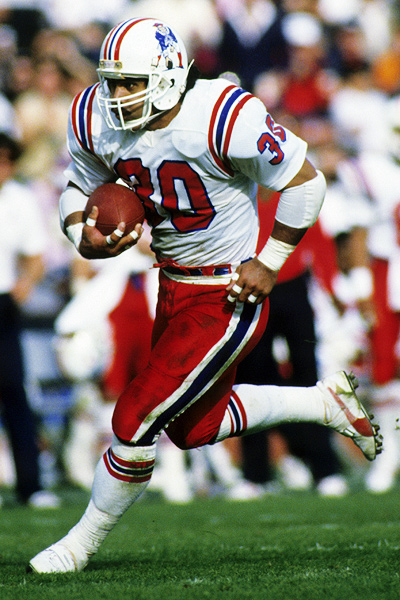
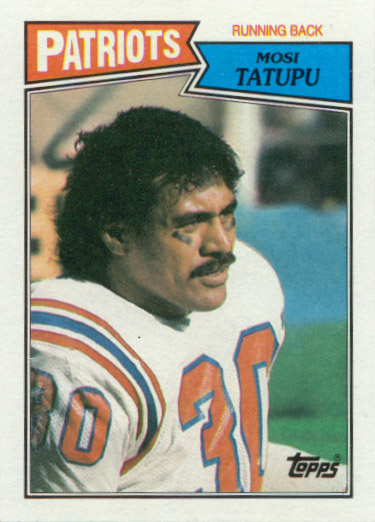
Mosi Tatupu, who died last February, starred as a fullback at USC, then played 13 seasons with the Patriots [team stats]. Mosi got those Saturday afternoons his son desperately wanted. He got that recognition.
And even though he had his doubts, Mosi worked so his son could have those same chances, that same career. He put together a highlight tape from Lofa’s freshman season at Maine and, unbeknownst to his son, sent the tape to Carroll and to then-USC linebacker coach Nick Holt.
Holt loved what he saw on tape, then took the tape to Carroll and said, “We need to look at this guy.”
Mosi also called Carroll. And he called Carroll again and again.
“At the time we were really scrapping for players,” Carroll said. “On the tape Mosi sent us, Lofa didn’t start in any of the games, but when he got in, he made almost every tackle. We couldn’t tell how fast he was. We only knew he was making a bunch of plays.
“We were hoping we could pull the trigger for Mosi, because we love him and all of that, but when we saw how small Lofa was we thought, ‘Oh boy.’ But we had scholarships, so we said, ‘Let’s just do it.’ I just hoped it was going to work out. Knowing the history and knowing how loved his father was, we knew how big a deal it was for Lofa, but we had no idea what we were getting.”
At worst, Carroll figured, he was doing a favor for a former Trojan. At best, well he got the best. He got a defensive leader in the middle of the football field.
“He just had this marvelous savvy,” Carroll said. “We fell in love with him and he became a great player. He was one of the best linebackers who ever played there.
“He learned very, very quickly. He made sense of stuff. He was just a natural at playing the position, just as he’s been here. I’m thrilled we gave him that scholarship. Not just for Lofa, but for Mosi too. I know how proud Mosi was of him.”
Tatupu redshirted in 2002, his first season at USC.
“He did a phenomenal job on the service team,” Holt said. “But we knew as soon as he started practicing that he was going to be a good player. He just had it. He understands football.”
Now after five NFL seasons and three Pro Bowl invitations, Tatupu has been reunited with his college coach. Today against San Francisco will be their first game together as player and coach in an NFL regular season.
“He’s absolutely the same guy that I had down there and it’s refreshing to know that it wasn’t just an act,” said Tatupu. “To have him back up here is fun.
“He still has his way of doing things. He keeps it light. Everybody here is having fun. It’s good to see that it wasn’t just an act. It wasn’t just for college. He knows how to win.”
And Tatupu, who left USC with one season of eligibility remaining, is the same player he was at USC, only now he weighs 250 pounds.
“He’s made the same transition here that he made from Maine to SC,” Carroll said. “When he was deciding whether to stay (at USC), I was battling for him to stay. I thought nobody would know about him. The buildup wasn’t there for it. But he told me, ‘I know I can do it.’ ”
Tatupu was asked last week if he thought he still owed Carroll for taking the chance and offering him a scholarship. He smiled.
“I was very appreciative of the opportunity,” said Tatupu, Seattle’s second-round pick in 2005. “Definitely some things had to go my way to get to where I am now and it started with that scholarship. But I also like to think I had a hand in helping Pete win those two national titles.”
In other words, Tatupu has paid his debt to Carroll, something his once-and-future coach readily acknowledges.
“He was a great Trojan,” Carroll said.
Full Article
Wednesday, August 11, 2010
Lofa Tatupu Faces First Season Without His Father
Especially now, in the first week of this first football season without his father.
Lofa Tatupu was named after Mosi, his dad, and this game has always bonded them.
"It has been tough," Lofa says, "Not to be able to call him during camp. I might tear up. I'm sorry."
He stops to swallow the lump in his throat. The pause is heartbreaking.
Mosiula Mea'alofa Tatupu. That is the full name of Seattle's starting middle linebacker, named for his father,
15-year NFL veteran Mosi Tatupu, who died in February.
Their middle names were different, but he was his father's son. Dad coached him in high school in Massachusetts, and when Lofa went looking for a college to transfer to after his freshman year at Division I-AA Maine, Mosi kept knocking on the door at his alma mater, USC, to convince Pete Carroll and the Trojans' coaches to give Lofa a shot.
But now Mosi is gone, passing one evening back in February. He went downstairs for a nap like he did every evening. A friend came down and found him on the couch holding something in his hand.
It was a prayer bead, one that Lofa's mother, Linnea Garcia-Tatupu, had given Mosi years before. The friend who found Mosi had never seen him holding it during his nap until that night.
"Almost like he knew," Lofa said.
It is a peaceful image from a tragic loss. Mosi, who suffered from high blood pressure, died from a massive heart attack. He was 54.
And so the son prepares for the first season without his father.
Lofa Tatupu, 27, is coming back from a torn pectoral muscle that ended his 2009 season after six games. The real uncertainty is whether he can return to the Pro Bowl form he showed his first three years in Seattle.
He was a star from the start in Seattle, a second-round pick in 2005 who solidified a position that had been a revolving door and made the Pro Bowl each of his first three seasons.
But the past two seasons have been riddled with injuries, from the thumb he broke in the 2009 season opener to the knee that was periodically drained, to the pectoral muscle that was torn off the bone.
Can he get back to playing at that level?
"Honestly, if I don't make another Pro Bowl, yeah that's upsetting," Lofa said, "But that's not the bowl I'm worried about."
He is back in the role that he feels most comfortable. The underdog. This is a player whom New Hampshire's coaches deemed too small coming out of high school.
He had to go to Maine before deciding to transfer, and even when USC took notice of him, the Trojans wanted him to walk on until they found out Oregon was going to offer him a scholarship.
Now, he is the heart of Seattle's defense, the one that Carroll is counting on to hold the linebackers together.
"By far, he's the guy that runs that group," Carroll said.
But Tatupu never lost that feeling of being overlooked and underestimated.
"You always got to have that chip, that edge," he said. "I never lost my edge."
If anything, it's sharpened by the loss of the father he is determined to honor this season. That's what he told his dad on the phone.
"Last time I ever spoke to him, I told him I was going to make him proud," Lofa said. "And that I loved him."
Full Article
Wednesday, February 24, 2010
Mosi Tatupu, Punahou Great and Former NFL Star, Passes Away
Mosi Tatupu, who played for the New England Patriots from 1978-1990 and was a star performer on special teams, died Tuesday at the age of 54, according to the Honolulu Star Bulletin.
The cause of death was unknown, according to the report, which also indicated that Tatupu suffered from high blood pressure and other ailments.
"He was one of those fun guys in the locker room who also had fun on the field," said former Patriots quarterback Steve Grogan, who was one of Tatupu's teammates in New England. "When he went to practice, he had a smile on his face all the time because he was having fun. He enjoyed playing football. He could have played in any era, for anybody at any time. It's a shame that he's gone at such an early age."
Tatupu played 13 seasons with the Patriots, starring as a special teams player (making the Pro Bowl in 1986) and as a jack-of-all trades running back. He was one of the most popular players of his era and even had his own cheering section at Schaefer/Sullivan Stadium called "Mosi's Mooses."
"I think football fans in this area appreciate a lunchpail attitude, someone who shows up for work every day and that's what Mosi did," Grogan said. "I think his personality, the spirit and fun he showed on the field, transferred to fans.
That's why they loved him so much."
He rushed for 2,415 yards over his career with the Patriots, scoring 18 touchdowns and averaging 3.9 yards per carry.
"He was not only a really good football player who could do a lot of different things for you, "Grogan said, "from special teams, to goal-line situations, coming out of backfield and catching the ball, blocking."
At the time of his death, Tatupu, a native of American Samoa and considered one of the greatest athletes in the history of Hawaii, was running backs coach at Curry College in Milton, Mass. Tatupu had also coached his son Lofa Tatupu -- now a linebacker for the Seattle Seahawks -- at King Philip Regional High School in Wrentham, Mass.
------------------------------------------------------------------------------------
Punahou 74’s Man in the O-Men Hall of Fame: Mosiula Tatupu
Without a doubt, the athlete in our class who received the most notice was Mosiula Tatupu, or “Mosi” as he is more familiarly known. In 1990, Mosi’s Punahou athletic achievements were recognized when he was named one of the 84 members of today’s Punahou’s O-Men Hall of Fame. The 1990 Punahou Bulletin Holiday edition included the citation for Mosi’s enshrinement on page 5. For your reading pleasure, it is reprinted here.
During his sixth grade, Mosi was a member of a pony league football team which included his close buddy, a student at Punahou. As a result of their friendship, Mosi persuaded his family to send him to Punahou the following year. This was a fortunate move for Punahou as Mosi became one of the greatest all-aroud athletes in Hawaii sports history.
In football, he was an All-State selection in his sophomore, junior and senior years. In his senior year he earned High School All American honors. He culminated his football career at Punahou by rushing for 182 yards in the Senior All Star game against the OIA’s best. His single season and three year high school career rushing records established in 1973, stood for 17 years until November 1990.
An outstanding basketball player, he won All-State honors and led his team to a State Championship in his senior year. In baseball, he was a power hitting outfielder and again a member of a State Championship team. During his Punahou career he won nine letters and was awarded numberous ILH and State All Star and MVP awards in all three sports.
Going on to the University of Southern California , he played four years for the Trojan football team. Former coach John McKay called Mosi the “best blocking back in USC history” and compared tackling Mosi to “tackling a Coke machine.” Mosi started several years as fullback and was a member of two Pac-10 championship squads plus a national championship team. He played also in several annual bowl games.
Mosi is starting his 12th year with the New England Patriots. He has been captain of the special teams for many years and made All Pro as a special teams player. Very active in civic events in his New England area, Mosi has won the affection of his community, his football fans and his fellow players. Mosi, welcome to the Hall of Fame!
Full Article
Thursday, January 28, 2010
Lofa Tatupu donates $10,000 to USA Football for Youth Football in American Samoa
Friday, October 9, 2009
Seahawks' Tatupu to Donate to Tsunami Relief
Seattle Seahawks defensive star Lofa Tatupu is donating up to $10,000 to aid disaster relief efforts in the Pacific Rim region. Coach Jim Mora said Wednesday his three-time Pro Bowl middle linebacker is volunteering to match the first $10,000 that fans donate in a collection drive started by the Seahawks and Medical Teams International.
Tatupu's father, former NFL player Mosi Tatupu, was born in Pago Pago, American Samoa, and Lofa Tatupu says he still has family there. Last week, a deadly tsunami hit the U.S. territory, as well as neighboring Samoa and Tonga.
The Seahawks are inviting fans to donate on their way into the stadium for Sunday's home game against Jacksonville.
Thursday, July 2, 2009
Lofa Tatupu Chuckled at an Interviewer’s Use of the Term “Offseason”
When asked what an NFL player does between the end of the final minicamp and the start of training camp, Seattle Seahawks linebacker Lofa Tatupu chuckled at an interviewer’s use of the term “offseason.” “There is no such thing as an offseason,” he said.
The Seahawks wrapped up a busy spring of training activities on Friday, and they’ll have nothing formally scheduled until camp starts at the end of July.
Much of the practicing since the end of last season has consisted of what they call OTAs (Organized Team Activities). In that vein, they now enter the phase that could be labeled UTAs (Unorganized Team Activities) or ISWs (Individual Self-Motivated Workouts).
But there certainly isn’t as much LAP (Lounging Around the Pool) as there used to be.
It’s only a vacation in the sense that their presence at Seahawks headquarters isn’t required.
“… Coaches go on vacation, the weight room kind of closes down, everybody gets out of town for six weeks,” quarterback Matt Hasselbeck said. “That’s the point where you’re on vacation, but that’s when you have got to kind of gear it up physically. That’s when you’ve really got to get in shape.”
Hasselbeck stays in the Seattle area and often gets together with teammates who conduct their own workouts.
The team activities through the spring have been crucial in learning the new staff’s playbook. Now, the focus for Hasselbeck is getting the arm ready for a long season of firing footballs.
“For me, it’s the most important time,” he said of his upcoming schedule that sometimes includes two workouts a day. “Similar to a pitcher, you get your arm ready for competitive throws. That’s when you really sharpen your skills, and you know you’re coming back to camp (where) there’s a conditioning test, a body-fat percentage test, there’s a weigh-in … all that stuff’s coming.”
Tatupu said he’s going home to Massachusetts, where he will work out with old friends and be accompanied by another steady companion … his playbook.
“You look it over every other day and jog the memory,” Tatupu said. “When you’re not physically taking the reps out there, you tend to forget assignments or how blitzes are run. In order to hit camp running, you have to be sharp mentally.”
The studying is even more important this summer because the players have to learn a new system, Tatupu said.
That situation led first-year coach Jim Mora to adopt a new approach.
“A lot of times, at the end of camp, you collect their playbooks,” Mora said. “In coaching sometimes, there’s a little paranoia about your information getting out. But we’re asking these guys to keep their books because we want them to study so they come back and it’s fresh in their minds. That’s different than I’ve ever done.”
After a fairly steady stretch of structured team workouts, Tatupu said that this part of the summer can be more playful. He likes to swim and play basketball. “But you can’t go too hard on the basketball court because you don’t want to roll an ankle.”
And when he hits the gym to lift weights, he shapes his schedule around those of his old friends who work out with him. “Hey, you’ve got to have spotters … you don’t want that bar falling on you.”
Training camp is no longer a time for players to work back into shape for the season; anybody taking that approach will be blatantly unprepared.
As Mora pointed out, there’s only 15 days of practice between the July 31 camp opening and the first preseason game. There’s no easing back into it.
It’s apparent that the players aren’t really looking for time off. In fact, that seems like a bad thing in the NFL.
“The sad part is that the only time off you really have is when you don’t make the playoffs,” Tatupu said. “Unfortunately, we found that out, and we found out that’s not a fun time off, either. It’s a sad time because you see the other teams having fun on the field and being out there chasing after the ring. That’s not what we want.”